
Brand alliances can be an effective method for differentiating especially a fungible product, say like bananas. In a commodity war of declining profits and upstart retail chains, one tactic a marketer and distributor like Chiquita Banana can use to differentiate itself is by co-branding its wares with Gerber baby food, Ben & Jerry's, or Mrs. Smith's Banana Cream Pies.
Keller (2008, p 289) says that co-branding can both broaden the meaning of a product and increase its access points. Co-Branding can (p. 290) create "compelling points of difference" and create access to a higher profit margin category. Spiller and Baier (2005, p 320) note that often a manufaturing intermediary has an inelastic demand for the price of a banana in comparison to shoppers at Wal-Mart (be nervous about any 800 pound gorillas in a closet with you). This is because the cost of a banana in a Cream Pie is a small part of the total cost of the ware.
References
Keller, K (2008), Strategic Brand Management. Pearson/Prentice-Hall.
Spiller, Lisa and Martin Baier (2005). Contemporary Direct Marketing. Pearson/Prentice-Hall
Showing posts with label brand. Show all posts
Showing posts with label brand. Show all posts
Saturday, September 12, 2009


Sunday, June 14, 2009
A New Logo for Wendy's?
Background
Wendy’s is an international fast food chain that ranks third in hamburger joints behind McDonald’s and Burger King (Hoover’s, 2009, p 1). It has over 6,500 locations in the United States and more than 20 countries worldwide. Management is considering changing the Wendy logo and brand character to keep it current. There is a concern that changing the well-known logo could have adverse repercussions. To study consumer opinion a series of personal interviews will be conducted.

According to Keller (pp 156-159), logos and brand characters are an easily recognizable way to identify a company and product. They are central to advertising campaigns and packaging. He says they can “create perceptions of the brand as fund and interesting.” However, (p. 158) he also notes they must be changed from time to time. Betty Crocker spent over $1M to update its tired brand character (pp 164-5). This $1M price tag is also the case for updating a logo (p. 157).
Sampling Method
The background information shows the importance of correctly updating a brand character, and that an appropriate budget must be allocated to this important task. Having an accurate cross-section that is representative of Wendy’s customers outweighs cost. We do not want to draw incorrect conclusions by using a sampling method known to be inaccurate.
The life-cycle of a sampling plan is to define the population, choose a data-collection method, identify a sampling frame, select a sampling method, determine sample size, develop operational procedures, execute the plan (see McDaniel and Gates, 2008, p330). This specific assignment is to select and justify a sampling method. Our first decision is between probability samples and non-probability samples. McDaniel and Gates (p. 334) note that probability samples are better for obtaining a representative cross section of our population. Given the importance of the logo or brand character, we need to have the best representation we can get. The trade-off is cost but we should have a budget commensurate with the task.
Next, we must decide among the several probability sampling methods. I like the stratified sample because it has a smaller sampling error than the other methods (see McDaniel and Gates, 2008, p. 341). It is more efficient because it eliminates one of more sources of variation through the stratification process. The researcher is making the “sample be more representative by making sure that important dimensions of the population are represented in their true population proportion.”
Wendy's should stratify on country. According to Hawkins, et al (2007, p 40) cultural factors that like language, demographics, values and nonverbal communications can impact marketing communications. A cultural faux pas with a brand character or logo can make Wendy’s appear like confused Martians. Using country to stratify, I can also avoid the main drawback on stratified sampling – we usually don’t know in advance the proportions of the strata (see McDaniel and Gates, 2008, p. 342). However, Wendy's consolidated financial statements do have that information.
Finally, should the method be proportional allocation or disproportional allocation? In this case, the method should be proportional because it is easy to calculate the relative number of locations in each country to the total number of locations (p 342). Within each country (strata), do simple random sampling with a sample size proportional to the relative percentage for the country.
To collect the data, the store intercept survey type can be used (see McDaniel and Gates, 2008, p. 150). As a style of mall-intercept survey, it would share many of the same advantages and disadvantages. The interviewer can show proposed Wendy’s logos, explain and probe (p. 171). On the other hand, the respondent may be distracted, or in a hurry. Further, there is a greater opportunity for interviewers to select the people to interview in a non-probabilistic manner. Strict operational procedures should be defined.
References
Hawkins, Del, David Mothersbaugh and Roger Best (2007). Consumer Behavior. McGraw-Hill/Irwin.
Hoovers (2009). Hoover's Profile: Wendy's International, Inc. Retrieved on June 7, 2009 from http://www.answers.com/topic/wendy-s-international
Johnson, E. (2009). Quantitative Research: Surveys & Sampling. Retrieved on June 7, 2009 from http://www.imc.wvu.edu/.
Keller, K (2008), Strategic Brand Management. Pearson/Prentice-Hall.
McDaniels, C and R Gates (2008). Marketing Research Essentials. John Wiley.
Wendy’s is an international fast food chain that ranks third in hamburger joints behind McDonald’s and Burger King (Hoover’s, 2009, p 1). It has over 6,500 locations in the United States and more than 20 countries worldwide. Management is considering changing the Wendy logo and brand character to keep it current. There is a concern that changing the well-known logo could have adverse repercussions. To study consumer opinion a series of personal interviews will be conducted.
According to Keller (pp 156-159), logos and brand characters are an easily recognizable way to identify a company and product. They are central to advertising campaigns and packaging. He says they can “create perceptions of the brand as fund and interesting.” However, (p. 158) he also notes they must be changed from time to time. Betty Crocker spent over $1M to update its tired brand character (pp 164-5). This $1M price tag is also the case for updating a logo (p. 157).
Sampling Method
The background information shows the importance of correctly updating a brand character, and that an appropriate budget must be allocated to this important task. Having an accurate cross-section that is representative of Wendy’s customers outweighs cost. We do not want to draw incorrect conclusions by using a sampling method known to be inaccurate.
The life-cycle of a sampling plan is to define the population, choose a data-collection method, identify a sampling frame, select a sampling method, determine sample size, develop operational procedures, execute the plan (see McDaniel and Gates, 2008, p330). This specific assignment is to select and justify a sampling method. Our first decision is between probability samples and non-probability samples. McDaniel and Gates (p. 334) note that probability samples are better for obtaining a representative cross section of our population. Given the importance of the logo or brand character, we need to have the best representation we can get. The trade-off is cost but we should have a budget commensurate with the task.
Next, we must decide among the several probability sampling methods. I like the stratified sample because it has a smaller sampling error than the other methods (see McDaniel and Gates, 2008, p. 341). It is more efficient because it eliminates one of more sources of variation through the stratification process. The researcher is making the “sample be more representative by making sure that important dimensions of the population are represented in their true population proportion.”
Wendy's should stratify on country. According to Hawkins, et al (2007, p 40) cultural factors that like language, demographics, values and nonverbal communications can impact marketing communications. A cultural faux pas with a brand character or logo can make Wendy’s appear like confused Martians. Using country to stratify, I can also avoid the main drawback on stratified sampling – we usually don’t know in advance the proportions of the strata (see McDaniel and Gates, 2008, p. 342). However, Wendy's consolidated financial statements do have that information.
Finally, should the method be proportional allocation or disproportional allocation? In this case, the method should be proportional because it is easy to calculate the relative number of locations in each country to the total number of locations (p 342). Within each country (strata), do simple random sampling with a sample size proportional to the relative percentage for the country.
To collect the data, the store intercept survey type can be used (see McDaniel and Gates, 2008, p. 150). As a style of mall-intercept survey, it would share many of the same advantages and disadvantages. The interviewer can show proposed Wendy’s logos, explain and probe (p. 171). On the other hand, the respondent may be distracted, or in a hurry. Further, there is a greater opportunity for interviewers to select the people to interview in a non-probabilistic manner. Strict operational procedures should be defined.
References
Hawkins, Del, David Mothersbaugh and Roger Best (2007). Consumer Behavior. McGraw-Hill/Irwin.
Hoovers (2009). Hoover's Profile: Wendy's International, Inc. Retrieved on June 7, 2009 from http://www.answers.com/topic/wendy-s-international
Johnson, E. (2009). Quantitative Research: Surveys & Sampling. Retrieved on June 7, 2009 from http://www.imc.wvu.edu/.
Keller, K (2008), Strategic Brand Management. Pearson/Prentice-Hall.
McDaniels, C and R Gates (2008). Marketing Research Essentials. John Wiley.
Sunday, December 28, 2008
MSN Brand Audit
Microsoft Network (MSN), also known as LIVE is a distant 3rd in Web site traffic, behind Yahoo and Google. In most portal categories MSN aka LIVE is competitive; it is the search service where it lags far behind the leaders. My WVU survey reveals that neither MSN nor LIVE have much brand awareness as search services.
There is great opportunity for MSN to increase revenues, though, because Google is not a commanding presence in portal services other than search. Likewise, Yahoo is struggling to maintain operations and is unable to keep current with advancing technology. Neither Google nor Yahoo have Social Capital with the most lucrative audience for Web advertising, “Strategic Buyers.” Microsoft does and this is also an important audience to Microsoft because of its vulnerability to Open Source, Software as a Service and other future industry directions.
For the complete brand audit with all recommendations see Redmond Review MSN Audit
There is great opportunity for MSN to increase revenues, though, because Google is not a commanding presence in portal services other than search. Likewise, Yahoo is struggling to maintain operations and is unable to keep current with advancing technology. Neither Google nor Yahoo have Social Capital with the most lucrative audience for Web advertising, “Strategic Buyers.” Microsoft does and this is also an important audience to Microsoft because of its vulnerability to Open Source, Software as a Service and other future industry directions.
For the complete brand audit with all recommendations see Redmond Review MSN Audit
Saturday, December 27, 2008
MSN Brand Exploratory
In a brand exploratory, Keller (2008, p 129) advises us to seek out prior research studies. EBSCOHOST has proved a valuable tool in this regards and analysis by Tancer, Rosoff and Chickakowski, among others provided real insight into the external, customer perceptions of the brand. In addition, Keller (p 129) recommends that interviews with internal personnel have a high payoff. While not able to do this, I did survey WVU students.
Products and Services
MSN/LIVE has two audience categories, the site visitors and advertisers. It has services for both. With MSN/LIVE, the most important audience is site visitors because without them, the advertisers will have no interest. The finding I have made in this brand exploratory is that site visitors like Google and Yahoo while advertisers like MSN.
External Perception of the Brand
According to Rosoff (2006, p 2), the MSN reputation suffers with site visitors. MSN has ranked last in a 2001 Consumer Reports customer satisfaction survey. Rosoff holds that MSN deploys technology for its own sake, which can decrease customer satisfaction with the site. He also finds that MSN editorial content needs improvement.
The MSN/LIVE search service is held to be full featured but the general public does perceive some deficiencies. It is interesting to note that both MSN and Yahoo used the same search engine, Inktomi, until 2004 when Yahoo bought Inktomi. Microsoft then developed its own search engine for MSN. Wall (2006, p 2) finds that MSN search does a poor job at link analysis and therefore its results have less relevancy than Yahoo or Google, as well as a bias to rank commercial sites too high.
Likewise, there are some areas of concern with Hotmail, be it called MSN or Windows LIVE Hotmail. Arrington (2007, p 1) finds that while it has an intuitive interface it has slow responsiveness. What is worse, MSN deletes all mail information every 30 days if the consumer does not login. Rafferty (2006, p 1) expressed concern with this policy when he lost important documentation as a result.
On the other hand, the general public holds MSNBC in high regards. IQ69 reports (2008, p 1) that MSNBC took the top spot in the University of Michigan American Customer Satisfaction Index (ACSI) survey. However, the ACSI survey did note that there does not appear to be a clear differentiator between news services and the leading brands are bunched together.
One specific public of interest is “strategic buyers.” Large corporations have made significant investments in the Microsoft franchise. They have end-users trained on mission critical systems that use Microsoft technology. They have trained their help-desk staff on Microsoft technology. They probably have significant Microsoft investment in the server room and with their application development staff as well.
Most importantly, Microsoft has the social capital of existing, defined relationships that make transactions easy to accomplish. Microsoft sales teams visit “strategic buyers” periodically and promptly answer phone calls. Microsoft is very good at relationship marketing. Every sales team has an architectural engineer assigned to it with the mission of understanding the information technology plan of assigned corporations, their enterprise architecture and how to advantageously apply Microsoft technology to affect solutions.
Competitive Environment from an Exploratory Viewpoint
MSN Competitive Exploratory
Marketing Support from an Exploratory Viewpoint
MSN Marketing Support Exploratory
An MSN, Yahoo and Google Perceptual Map
References
Arrigngton, Michael (February 8, 2007). Tech Crunch. Retrieved on December 2, 2008 from http://www.techcrunch.com/2007/02/08/a-comparison-of-live-hotmail-gmail-and-yahoo-mail/all-comments/
Chickowski, Erica (02/08/2008). Brand Identities After a Microsoft and Yahoo Deal. Baseline. Retrieved on November 22, 2008 from http://www.baselinemag.com/c/a/Messaging-and-Collaboration/Brand-Identities-After-a-Microsoft-Yahoo-Deal/1/
IQ69 (August 14, 2008). Yahoo tops Google in customer satisfaction survey. Retrieved on December 2, 2008 from http://iq69.com/index.php/2007/08/14/yahoo-tops-google-in-customer-satisfaction-survey/
Keller, K (2008). Strategic Brand Management. Pearson/Prentice-Hall.
Rosoff, M (October 23, 2006). The Future of MSN. Directions on Microsoft. Retrieved on November 22, 2008 from http://www.directionsonmicrosoft.com/sample/DOMIS/update/2006/11nov/1106tfom.htm#top
Tancer, Bill (August 3, 2006). Google, Yahoo! and MSN: Brand Association. Hitwise Intelligence. Retrieved on November 22, 2008 from http://weblogs.hitwise.com/bill-tancer/2006/08/google_yahoo_and_msn_brand_ass.html
Wall, Aaron (June 13, 2006). How Search Engines Work: Search Engine Relevancy Reviewed. Search Engine Optimization. Retrieved on December 2, 2008 from http://www.seobook.com/relevancy/%23short
Products and Services
MSN/LIVE has two audience categories, the site visitors and advertisers. It has services for both. With MSN/LIVE, the most important audience is site visitors because without them, the advertisers will have no interest. The finding I have made in this brand exploratory is that site visitors like Google and Yahoo while advertisers like MSN.
External Perception of the Brand
According to Rosoff (2006, p 2), the MSN reputation suffers with site visitors. MSN has ranked last in a 2001 Consumer Reports customer satisfaction survey. Rosoff holds that MSN deploys technology for its own sake, which can decrease customer satisfaction with the site. He also finds that MSN editorial content needs improvement.
The MSN/LIVE search service is held to be full featured but the general public does perceive some deficiencies. It is interesting to note that both MSN and Yahoo used the same search engine, Inktomi, until 2004 when Yahoo bought Inktomi. Microsoft then developed its own search engine for MSN. Wall (2006, p 2) finds that MSN search does a poor job at link analysis and therefore its results have less relevancy than Yahoo or Google, as well as a bias to rank commercial sites too high.
Likewise, there are some areas of concern with Hotmail, be it called MSN or Windows LIVE Hotmail. Arrington (2007, p 1) finds that while it has an intuitive interface it has slow responsiveness. What is worse, MSN deletes all mail information every 30 days if the consumer does not login. Rafferty (2006, p 1) expressed concern with this policy when he lost important documentation as a result.
On the other hand, the general public holds MSNBC in high regards. IQ69 reports (2008, p 1) that MSNBC took the top spot in the University of Michigan American Customer Satisfaction Index (ACSI) survey. However, the ACSI survey did note that there does not appear to be a clear differentiator between news services and the leading brands are bunched together.
One specific public of interest is “strategic buyers.” Large corporations have made significant investments in the Microsoft franchise. They have end-users trained on mission critical systems that use Microsoft technology. They have trained their help-desk staff on Microsoft technology. They probably have significant Microsoft investment in the server room and with their application development staff as well.
Most importantly, Microsoft has the social capital of existing, defined relationships that make transactions easy to accomplish. Microsoft sales teams visit “strategic buyers” periodically and promptly answer phone calls. Microsoft is very good at relationship marketing. Every sales team has an architectural engineer assigned to it with the mission of understanding the information technology plan of assigned corporations, their enterprise architecture and how to advantageously apply Microsoft technology to affect solutions.
Competitive Environment from an Exploratory Viewpoint
MSN Competitive Exploratory
Marketing Support from an Exploratory Viewpoint
MSN Marketing Support Exploratory
An MSN, Yahoo and Google Perceptual Map
References
Arrigngton, Michael (February 8, 2007). Tech Crunch. Retrieved on December 2, 2008 from http://www.techcrunch.com/2007/02/08/a-comparison-of-live-hotmail-gmail-and-yahoo-mail/all-comments/
Chickowski, Erica (02/08/2008). Brand Identities After a Microsoft and Yahoo Deal. Baseline. Retrieved on November 22, 2008 from http://www.baselinemag.com/c/a/Messaging-and-Collaboration/Brand-Identities-After-a-Microsoft-Yahoo-Deal/1/
IQ69 (August 14, 2008). Yahoo tops Google in customer satisfaction survey. Retrieved on December 2, 2008 from http://iq69.com/index.php/2007/08/14/yahoo-tops-google-in-customer-satisfaction-survey/
Keller, K (2008). Strategic Brand Management. Pearson/Prentice-Hall.
Rosoff, M (October 23, 2006). The Future of MSN. Directions on Microsoft. Retrieved on November 22, 2008 from http://www.directionsonmicrosoft.com/sample/DOMIS/update/2006/11nov/1106tfom.htm#top
Tancer, Bill (August 3, 2006). Google, Yahoo! and MSN: Brand Association. Hitwise Intelligence. Retrieved on November 22, 2008 from http://weblogs.hitwise.com/bill-tancer/2006/08/google_yahoo_and_msn_brand_ass.html
Wall, Aaron (June 13, 2006). How Search Engines Work: Search Engine Relevancy Reviewed. Search Engine Optimization. Retrieved on December 2, 2008 from http://www.seobook.com/relevancy/%23short
Sunday, December 21, 2008
MSN Brand Inventory
According to Keller (2008, p 129), an inventory is a “supply-side” view of the brand. He also notes that an inventory profiles competitors to understand points of parity and points of difference.
Products and Services Offered
From 1995 through 2005, MSN was the umbrella brand for all online services offered from Microsoft (see Rosoff, 2006, p 1). Beginning in 2006, the Windows LIVE brand was introduced and applied to certain online properties with a goal of reinvigorating them to compete more effectively through association with the Windows brand name. For example, MSN Hotmail became Windows LIVE Mail, MSN Messenger became Windows LIVE Messenger, and MSN Search became LIVE Search. However, Rosoff (p1) goes on to note that several of the MSN brand names are category traffic leaders so that Microsoft decided to also keep the MSN brand for many online services.
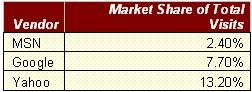
Tancer (2008, pp 1-2) works at Experian, and uses the Experian categories for segmenting online services. MSN has a point of parity in each Experian category, with the exception of Sports, Employment, and Personality. In terms of total share of Internet visits, MSN captures 2.4% compared with Google at 7.7% and Yahoo at 13.2%. Both MSN and Yahoo have portal services that Google does not. SiteSeeker (2008, p 1) characterizes search as the dominant service in the competition between the three giants. Rosoff and Tancer have a more balanced perspective that includes a complete set of online services that draws traffic to the site.
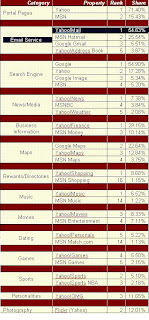
In its SEC 10-K filing (see SEC, June 30, 2008), Microsoft characterizes its Online Services Business as an online advertising platform. This platform offers personal communication services such as email and messaging, the MSN portal, LIVE Search, MSN Hotmail, MSN Mobile Services, MSN Premium Web Services, MapPoint and MSN Internet Access. Here is a list of MSN properties with sufficient traffic to rank in the top four sites by category.

Now I will review the MSN services that attract advertisers to the site. There is a parallel set of products and services to support marketing efforts to advertisers, the paying customers for the MSN brands. Sterling (2005, p 1) reports that the MSN AdCenter product is well liked by advertisers. It has advanced demographic and psychograhic mapping capabilities that allow them to better target communications. Marketing Vox (2006, p 1) commended MSN on the high quality of its AdCenter platform.
To help advertisers optimize their return on investment with MSN, Microsoft now offers a training program and a certification credential. The training program instructs advertiser staff on different strategies and tactics to use for different marketing communications to different publics. Zol reports (2007, p 1) that this is important and needed for point of parity in the category. Keller (p 110) notes that MSN’s service is not required to be equal to Google to establish a point of parity but rather just “good enough.”
Finally, Microsoft offers a community forum to assist advertisers with their Web marketing through commentary by Web analytics experts, software development experts who talk about the ability to customize AdCenter services through application programming interfaces, and a variety of other topics. A typical example is Brian Eisenberg discussing the Seven Biggest Mistakes of Web Analytics (see Ad Center).
Links to other aspects of the inventory follow:
MSN Competitive Environment Inventory
MSN Marketing Support Programs
MSN Brand Hierarchy
Evaluating MSN against Keller's Six Criteria
References
Chickowski, Erica (02/08/2008). Brand Identities After a Microsoft and Yahoo Deal. Baseline. Retrieved on November 22, 2008 from http://www.baselinemag.com/c/a/Messaging-and-Collaboration/Brand-Identities-After-a-Microsoft-Yahoo-Deal/1/
Keller, K (2008). Strategic Brand Management. Pearson/Prentice-Hall.
Marketing Vox, (October 4, 2007). Ballmer Sees Ad Revenue as Microsoft's Future. Retrieved on November 19, 2008 from http://www.marketingvox.com/ballmer-sees-ad-revenue-as-microsofts-future-033446/
Rosoff, M (October 23, 2006). The Future of MSN. Directions on Microsoft. Retrieved on November 22, 2008 from http://www.directionsonmicrosoft.com/sample/DOMIS/update/2006/11nov/1106tfom.htm#top
Site-Seeker (2007). Search Engines. Retrieved on November 15, 2008 from http://www.site-seeker.com/seocompetition.cfm
SEC (June 30, 2008). Microsoft Corporation Form 10-K. Retrieved on November 19, 2008 from http://www.sec.gov/Archives/edgar/data/789019/000119312508162768/d10k.htm
Sterling, Greg (March 17, 2005). MSN AdCenter. Search Engine Journal Retrieved on December 2, 2008 from http://www.searchenginejournal.com/msn-adcenter-joins-yahoo-and-google-in-search-advertising/1438/
Tancer, Bill (August 3, 2006). Google, Yahoo! and MSN: Brand Association. Hitwise Intelligence. Retrieved on November 22, 2008 from http://weblogs.hitwise.com/bill-tancer/2006/08/google_yahoo_and_msn_brand_ass.html
Zol, James (December 3, 2007). Google, Yahoo!, and MSN All Offer Accreditation Now. Semvironment. Retrieved on December 2, 2008 from http://www.semvironment.com/google-yahoo-and-msn-all-offer-accreditation-now/
Products and Services Offered
From 1995 through 2005, MSN was the umbrella brand for all online services offered from Microsoft (see Rosoff, 2006, p 1). Beginning in 2006, the Windows LIVE brand was introduced and applied to certain online properties with a goal of reinvigorating them to compete more effectively through association with the Windows brand name. For example, MSN Hotmail became Windows LIVE Mail, MSN Messenger became Windows LIVE Messenger, and MSN Search became LIVE Search. However, Rosoff (p1) goes on to note that several of the MSN brand names are category traffic leaders so that Microsoft decided to also keep the MSN brand for many online services.
Tancer (2008, pp 1-2) works at Experian, and uses the Experian categories for segmenting online services. MSN has a point of parity in each Experian category, with the exception of Sports, Employment, and Personality. In terms of total share of Internet visits, MSN captures 2.4% compared with Google at 7.7% and Yahoo at 13.2%. Both MSN and Yahoo have portal services that Google does not. SiteSeeker (2008, p 1) characterizes search as the dominant service in the competition between the three giants. Rosoff and Tancer have a more balanced perspective that includes a complete set of online services that draws traffic to the site.
In its SEC 10-K filing (see SEC, June 30, 2008), Microsoft characterizes its Online Services Business as an online advertising platform. This platform offers personal communication services such as email and messaging, the MSN portal, LIVE Search, MSN Hotmail, MSN Mobile Services, MSN Premium Web Services, MapPoint and MSN Internet Access. Here is a list of MSN properties with sufficient traffic to rank in the top four sites by category.

Now I will review the MSN services that attract advertisers to the site. There is a parallel set of products and services to support marketing efforts to advertisers, the paying customers for the MSN brands. Sterling (2005, p 1) reports that the MSN AdCenter product is well liked by advertisers. It has advanced demographic and psychograhic mapping capabilities that allow them to better target communications. Marketing Vox (2006, p 1) commended MSN on the high quality of its AdCenter platform.
To help advertisers optimize their return on investment with MSN, Microsoft now offers a training program and a certification credential. The training program instructs advertiser staff on different strategies and tactics to use for different marketing communications to different publics. Zol reports (2007, p 1) that this is important and needed for point of parity in the category. Keller (p 110) notes that MSN’s service is not required to be equal to Google to establish a point of parity but rather just “good enough.”
Finally, Microsoft offers a community forum to assist advertisers with their Web marketing through commentary by Web analytics experts, software development experts who talk about the ability to customize AdCenter services through application programming interfaces, and a variety of other topics. A typical example is Brian Eisenberg discussing the Seven Biggest Mistakes of Web Analytics (see Ad Center).
Links to other aspects of the inventory follow:
MSN Competitive Environment Inventory
MSN Marketing Support Programs
MSN Brand Hierarchy
Evaluating MSN against Keller's Six Criteria
References
Chickowski, Erica (02/08/2008). Brand Identities After a Microsoft and Yahoo Deal. Baseline. Retrieved on November 22, 2008 from http://www.baselinemag.com/c/a/Messaging-and-Collaboration/Brand-Identities-After-a-Microsoft-Yahoo-Deal/1/
Keller, K (2008). Strategic Brand Management. Pearson/Prentice-Hall.
Marketing Vox, (October 4, 2007). Ballmer Sees Ad Revenue as Microsoft's Future. Retrieved on November 19, 2008 from http://www.marketingvox.com/ballmer-sees-ad-revenue-as-microsofts-future-033446/
Rosoff, M (October 23, 2006). The Future of MSN. Directions on Microsoft. Retrieved on November 22, 2008 from http://www.directionsonmicrosoft.com/sample/DOMIS/update/2006/11nov/1106tfom.htm#top
Site-Seeker (2007). Search Engines. Retrieved on November 15, 2008 from http://www.site-seeker.com/seocompetition.cfm
SEC (June 30, 2008). Microsoft Corporation Form 10-K. Retrieved on November 19, 2008 from http://www.sec.gov/Archives/edgar/data/789019/000119312508162768/d10k.htm
Sterling, Greg (March 17, 2005). MSN AdCenter. Search Engine Journal Retrieved on December 2, 2008 from http://www.searchenginejournal.com/msn-adcenter-joins-yahoo-and-google-in-search-advertising/1438/
Tancer, Bill (August 3, 2006). Google, Yahoo! and MSN: Brand Association. Hitwise Intelligence. Retrieved on November 22, 2008 from http://weblogs.hitwise.com/bill-tancer/2006/08/google_yahoo_and_msn_brand_ass.html
Zol, James (December 3, 2007). Google, Yahoo!, and MSN All Offer Accreditation Now. Semvironment. Retrieved on December 2, 2008 from http://www.semvironment.com/google-yahoo-and-msn-all-offer-accreditation-now/
MSN Competitive Environment Inventory
Market Share
According to Tancer (2008, p 1), the market share for Internet visits are:
Tancer goes on to breakdown the total visits into the Experian Web site segments as follows.
Click image to expand.
Market Segments and MSN Points of Parity
Chickowski (2008, p 2) notes that Yahoo, Google and MSN all offer similar services, although Google has been far more effective in establishing points of difference in services that attract high page hits. A chart of favorable brand salience with each group is based on the studies of Rosoff (2006), Tancer (2006), and Chickakowski (2008).
Microsoft can use this chart to map its competitive brand strategy for MSN/LIVE. As we will see in the next section, MSN has strong presence in the Editor Collated Content arena. I propose this area can be exploited to establish rich communications with strategic buyers by placing noteworthy Editor’s in a Corporate Governance line extension of MSN/LIVE. In addition, MSN has a valid point of presence in each category.
Like Yahoo, MSN has the same set of tools and applications as those provided by Google, according to Chickakowski (2008, p 2). Keller (p 110) notes that MSN’s service is not required to be equal to Google to establish a point of parity but rather just “good enough.” Finally, the Tancer (2006, p 1) study found that while Yahoo was considered as a destination site and Google as a search site, MSN/LIVE was both.
Click image to expand.

MSN Points of Difference
According to Rosoff (2006, p 2), MSN makes content available that is collated by editors who work for either MSN or an MSN content partner. As noted in sections one and four, my proposal is to create customized and searchable corporate governance collections for customers who are strategic buyers. They will be attracted to Editor Collated Content that has been customized for them and that regards corporate governance. This will not only create a rich communication with these wealthy buyers on MSN/LIVE and thereby enhance the MSN operations, but will also enhance the communications between Microsoft and these corporate clients, which are increasingly lured by Open Source and “Software as a Service” alternatives to Windows.
Another point of difference would be that Microsoft has major resources world-wide that it can utilize to provide customer assistance to strategic buyers. It has a skillful sales force that is accustomed to fulfilling demanding assignments. It has a well-organized support structure to disseminate information and software updates as well as a competent consulting arm (MCS) with a field-tested project methodology that has a proven record of success. Finally, Microsoft has stable relations with the corporate world, which makes negotiating and executing contracts straightforward. This is known as social capital.
References
Chickowski, Erica (02/08/2008). Brand Identities After a Microsoft and Yahoo Deal. Baseline. Retrieved on November 22, 2008 from http://www.baselinemag.com/c/a/Messaging-and-Collaboration/Brand-Identities-After-a-Microsoft-Yahoo-Deal/1/
Keller, K (2008). Strategic Brand Management. Pearson/Prentice-Hall.
Rosoff, M (October 23, 2006). The Future of MSN. Directions on Microsoft. Retrieved on November 22, 2008 from http://www.directionsonmicrosoft.com/sample/DOMIS/update/2006/11nov/1106tfom.htm#top
Tancer, Bill (August 3, 2006). Google, Yahoo! and MSN: Brand Association. Hitwise Intelligence. Retrieved on November 22, 2008 from http://weblogs.hitwise.com/bill-tancer/2006/08/google_yahoo_and_msn_brand_ass.html
According to Tancer (2008, p 1), the market share for Internet visits are:

Tancer goes on to breakdown the total visits into the Experian Web site segments as follows.
Click image to expand.

Market Segments and MSN Points of Parity
Chickowski (2008, p 2) notes that Yahoo, Google and MSN all offer similar services, although Google has been far more effective in establishing points of difference in services that attract high page hits. A chart of favorable brand salience with each group is based on the studies of Rosoff (2006), Tancer (2006), and Chickakowski (2008).
Microsoft can use this chart to map its competitive brand strategy for MSN/LIVE. As we will see in the next section, MSN has strong presence in the Editor Collated Content arena. I propose this area can be exploited to establish rich communications with strategic buyers by placing noteworthy Editor’s in a Corporate Governance line extension of MSN/LIVE. In addition, MSN has a valid point of presence in each category.
Like Yahoo, MSN has the same set of tools and applications as those provided by Google, according to Chickakowski (2008, p 2). Keller (p 110) notes that MSN’s service is not required to be equal to Google to establish a point of parity but rather just “good enough.” Finally, the Tancer (2006, p 1) study found that while Yahoo was considered as a destination site and Google as a search site, MSN/LIVE was both.
Click image to expand.

MSN Points of Difference
According to Rosoff (2006, p 2), MSN makes content available that is collated by editors who work for either MSN or an MSN content partner. As noted in sections one and four, my proposal is to create customized and searchable corporate governance collections for customers who are strategic buyers. They will be attracted to Editor Collated Content that has been customized for them and that regards corporate governance. This will not only create a rich communication with these wealthy buyers on MSN/LIVE and thereby enhance the MSN operations, but will also enhance the communications between Microsoft and these corporate clients, which are increasingly lured by Open Source and “Software as a Service” alternatives to Windows.
Another point of difference would be that Microsoft has major resources world-wide that it can utilize to provide customer assistance to strategic buyers. It has a skillful sales force that is accustomed to fulfilling demanding assignments. It has a well-organized support structure to disseminate information and software updates as well as a competent consulting arm (MCS) with a field-tested project methodology that has a proven record of success. Finally, Microsoft has stable relations with the corporate world, which makes negotiating and executing contracts straightforward. This is known as social capital.
References
Chickowski, Erica (02/08/2008). Brand Identities After a Microsoft and Yahoo Deal. Baseline. Retrieved on November 22, 2008 from http://www.baselinemag.com/c/a/Messaging-and-Collaboration/Brand-Identities-After-a-Microsoft-Yahoo-Deal/1/
Keller, K (2008). Strategic Brand Management. Pearson/Prentice-Hall.
Rosoff, M (October 23, 2006). The Future of MSN. Directions on Microsoft. Retrieved on November 22, 2008 from http://www.directionsonmicrosoft.com/sample/DOMIS/update/2006/11nov/1106tfom.htm#top
Tancer, Bill (August 3, 2006). Google, Yahoo! and MSN: Brand Association. Hitwise Intelligence. Retrieved on November 22, 2008 from http://weblogs.hitwise.com/bill-tancer/2006/08/google_yahoo_and_msn_brand_ass.html
Evaluating MSN against Keller’s Six Criteria
Keller (2008, p 140) uses six evaluation factors to study and define a brand image. The criteria are: 1.) Memorability; 2.) Meaningfulness; 3.) Likeability; 4.) Transferability; 5.) Adaptability; and 6.) Protectability.
Memorability
Keller (p 147) discusses brand name aspects that can increase memorability and awareness. Two important aspects are “simple to say” and “easy to spell.” That is the case with MSN and LIVE. A brand name should likewise be familiar and meaningful. MSN does have familiarity in that it is a contraction of MS Network or Microsoft Network. Windows LIVE also has associations with Microsoft. Both can thus draw on associations with Microsoft. Furthermore, Keller holds that the name should be distinctive. The word Network distinguishes MSN from Microsoft and the three-letter acronym nature of the brand name is an orthographic device to distinguish the name with linguistic characteristics (see Keller, 2008, p 152).
Meaningfulness and Likability
The MSN logo has rich meaning. The logo is a butterfly, which has meaning on several levels. Russell (2003, p 1) notes that it has long been a symbol of transformation. In the case of both Microsoft and its customers, the transition is to the new world founded by the Internet. Russell also holds that our fascination with the butterfly is because if it “mesmerizing beauty.”
For each market segment there are two types of MSN customer. The first is the site visitor who wants to use the services offered by MSN. The second are advertisers who want to communicate with the site visitors. MSN has a mantra for the advertisers: “Easy to sell, easy to buy.” Experienced advertising professionals at MSN make the mantra true in actual practice according to Cuneo (2003, p 1) in Advertising Age.
Transferability and Adaptability
Keller defines two aspects of transferability (pp 142-3). The first is the ability of a brand to transfer across categories. For example, how well do the Microsoft Network brand elements transfer to a news channel? Shepard (1997, pp 35-8) discusses the marriage of MSN and NBC into MSNBC one of the sub-brands in the MSN portfolio. She found Microsoft bringing Internet and technology credibility to the joint venture and NBC the news credentials and trust. This is still one of the most successful Internet news programs. The second aspect of transferability is to add brand equity across geographical boundaries. Again, Microsoft Network has done this. Koranteng (2004, p 1) observes “that Microsoft Network [has] presence in 40 countries.”
Keller defines Adaptability (p 143) as the brand elements capacity to address change over time in competitors, or in consumer tastes. Both have happened to Microsoft Network during its history. Its first competitor was AOL, America On-Line in the mid-1990s. As late as 2001, MSN had still not dispatched AOL as a portal competitor and the Seattle Times (2002, p 1) reports that Microsoft spent $300M in the launch of the Butterfly Logo as a campaign against a still powerful AOL. Since that time, AOL has faded as a portal site and now Microsoft faces two new powerful competitors in Google and Yahoo.
Their surprising success resulted in MSN losing its footing. However, it is now reorganizing and as Kafka (2008, p 1) reports is actually gaining market share on both Google and Yahoo in the early part of this year.
Protectibility
Keller categorizes two types of protection for brand elements: 1.) Legal; and 2.) Competitive. A logo such as the MSN Butterfly and the Microsoft Network brand name can be legally protected especially when unauthorized use is a bad faith attempt to mislead the public and misdirect trade and economic livelihood from a corporate body that has invested in that name for commercial purpose (see Wikipedia, 2008a, p 1). Trademarks and registered names also receive international recognition and protection.
References
Kafka, Peter (January 18, 2008). Nielsen: Google, Yahoo, Losing Search Share To MSN. (Not A Typo). Silicon Valley Insider. Retrieved on November 24, 2008 from http://www.alleyinsider.com/2008/01/nielsen-google-yahoo-losing-search-share-to-msn-not-a-typo.html
Keller, K (2008). Strategic Brand Management. Pearson/Prentice-Hall.
Koranteng, Juliana (11/20/2004). MSN's Euro Moves. Billboard. Retrieved on November 24, 2008 from EBSCOHOST.
Seattle Time (October 14, 2002). Microsoft Puts $300 Million into MSN Internet Service Butterfly Campaign. Retrieved on November 24, 2008 from EBSCOHOST.
Shepard, Alica (March 1997). Webward Ho. American Journalism Review. Retrieved on November 24, 2008 from EBSCOHOST.
Wikipedia (2008a). Trademarks. Retrieved on November 24, 2008 from http://en.wikipedia.org/wiki/Trademark
Memorability
Keller (p 147) discusses brand name aspects that can increase memorability and awareness. Two important aspects are “simple to say” and “easy to spell.” That is the case with MSN and LIVE. A brand name should likewise be familiar and meaningful. MSN does have familiarity in that it is a contraction of MS Network or Microsoft Network. Windows LIVE also has associations with Microsoft. Both can thus draw on associations with Microsoft. Furthermore, Keller holds that the name should be distinctive. The word Network distinguishes MSN from Microsoft and the three-letter acronym nature of the brand name is an orthographic device to distinguish the name with linguistic characteristics (see Keller, 2008, p 152).
Meaningfulness and Likability
The MSN logo has rich meaning. The logo is a butterfly, which has meaning on several levels. Russell (2003, p 1) notes that it has long been a symbol of transformation. In the case of both Microsoft and its customers, the transition is to the new world founded by the Internet. Russell also holds that our fascination with the butterfly is because if it “mesmerizing beauty.”
For each market segment there are two types of MSN customer. The first is the site visitor who wants to use the services offered by MSN. The second are advertisers who want to communicate with the site visitors. MSN has a mantra for the advertisers: “Easy to sell, easy to buy.” Experienced advertising professionals at MSN make the mantra true in actual practice according to Cuneo (2003, p 1) in Advertising Age.
Transferability and Adaptability
Keller defines two aspects of transferability (pp 142-3). The first is the ability of a brand to transfer across categories. For example, how well do the Microsoft Network brand elements transfer to a news channel? Shepard (1997, pp 35-8) discusses the marriage of MSN and NBC into MSNBC one of the sub-brands in the MSN portfolio. She found Microsoft bringing Internet and technology credibility to the joint venture and NBC the news credentials and trust. This is still one of the most successful Internet news programs. The second aspect of transferability is to add brand equity across geographical boundaries. Again, Microsoft Network has done this. Koranteng (2004, p 1) observes “that Microsoft Network [has] presence in 40 countries.”
Keller defines Adaptability (p 143) as the brand elements capacity to address change over time in competitors, or in consumer tastes. Both have happened to Microsoft Network during its history. Its first competitor was AOL, America On-Line in the mid-1990s. As late as 2001, MSN had still not dispatched AOL as a portal competitor and the Seattle Times (2002, p 1) reports that Microsoft spent $300M in the launch of the Butterfly Logo as a campaign against a still powerful AOL. Since that time, AOL has faded as a portal site and now Microsoft faces two new powerful competitors in Google and Yahoo.
Their surprising success resulted in MSN losing its footing. However, it is now reorganizing and as Kafka (2008, p 1) reports is actually gaining market share on both Google and Yahoo in the early part of this year.
Protectibility
Keller categorizes two types of protection for brand elements: 1.) Legal; and 2.) Competitive. A logo such as the MSN Butterfly and the Microsoft Network brand name can be legally protected especially when unauthorized use is a bad faith attempt to mislead the public and misdirect trade and economic livelihood from a corporate body that has invested in that name for commercial purpose (see Wikipedia, 2008a, p 1). Trademarks and registered names also receive international recognition and protection.
References
Kafka, Peter (January 18, 2008). Nielsen: Google, Yahoo, Losing Search Share To MSN. (Not A Typo). Silicon Valley Insider. Retrieved on November 24, 2008 from http://www.alleyinsider.com/2008/01/nielsen-google-yahoo-losing-search-share-to-msn-not-a-typo.html
Keller, K (2008). Strategic Brand Management. Pearson/Prentice-Hall.
Koranteng, Juliana (11/20/2004). MSN's Euro Moves. Billboard. Retrieved on November 24, 2008 from EBSCOHOST.
Seattle Time (October 14, 2002). Microsoft Puts $300 Million into MSN Internet Service Butterfly Campaign. Retrieved on November 24, 2008 from EBSCOHOST.
Shepard, Alica (March 1997). Webward Ho. American Journalism Review. Retrieved on November 24, 2008 from EBSCOHOST.
Wikipedia (2008a). Trademarks. Retrieved on November 24, 2008 from http://en.wikipedia.org/wiki/Trademark
MSN Marketing Support Programs
Keller (p 131) observes that to achieve the ideal positioning of a brand and obtain congruence between what customers currently believe about the brand and what they will value in the brand, a strong supporting marketing program must be in place. Microsoft Network does have a strong marketing support program and it has evolved throughout its history. The products are listed above in section 2.1 and will be listed again in section 2.4 below on competitor analysis. The place is the Internet, now including mobile.
MSN has used a variety of promotional strategies over the past 14 years. Brandweek (2000, p 1) reported on a common marketing tactic for MSN, which is to sponsor events that can be reported and tracked on the Internet. Sponsorship is one aspect to MSN marketing support, and these events helped MSN prove the value of online tracking.
Carter (2005, p 1) describes how MSN incorporates TV and online advertising with events to promote the Microsoft Network brand. This work is coordinated by McCann-Erickson and is coordinated across countries. In the case of the launch of LIVE’s new search engine, the campaigns in the United States, United Kingdom, Canada, Australia and Brazil were all synchronized.
Haar reports (1998, p 1) that in its early years, Microsoft had an annual $100M marketing budget for MSN. MSN does not advertise solely to generate site traffic. They also market to advertisers and Microsoft believes that its technical skill will give it a competitive edge. Finally, the MSN advertising engine can be customized for each advertiser, and so personalization is another marketing support program tactic.
References
Brandweek (04/03/2000). Silver Awards. Retrieved on November 24, 2008 from EBSCOHOST.
Carter, B (2/5/2005). MSN takes on Google with search engine launch. Marketing. Retrieved on November 24, 2008 from EBSCOHOST.
Haar, S (1998). MSN Holds Back Marketing Bucks Until 1999. Interactive Week. Retrieved on November 24, 2008 from EBSCOHOST.
Keller, K (2008). Strategic Brand Management. Pearson/Prentice-Hall.
MSN has used a variety of promotional strategies over the past 14 years. Brandweek (2000, p 1) reported on a common marketing tactic for MSN, which is to sponsor events that can be reported and tracked on the Internet. Sponsorship is one aspect to MSN marketing support, and these events helped MSN prove the value of online tracking.
Carter (2005, p 1) describes how MSN incorporates TV and online advertising with events to promote the Microsoft Network brand. This work is coordinated by McCann-Erickson and is coordinated across countries. In the case of the launch of LIVE’s new search engine, the campaigns in the United States, United Kingdom, Canada, Australia and Brazil were all synchronized.
Haar reports (1998, p 1) that in its early years, Microsoft had an annual $100M marketing budget for MSN. MSN does not advertise solely to generate site traffic. They also market to advertisers and Microsoft believes that its technical skill will give it a competitive edge. Finally, the MSN advertising engine can be customized for each advertiser, and so personalization is another marketing support program tactic.
References
Brandweek (04/03/2000). Silver Awards. Retrieved on November 24, 2008 from EBSCOHOST.
Carter, B (2/5/2005). MSN takes on Google with search engine launch. Marketing. Retrieved on November 24, 2008 from EBSCOHOST.
Haar, S (1998). MSN Holds Back Marketing Bucks Until 1999. Interactive Week. Retrieved on November 24, 2008 from EBSCOHOST.
Keller, K (2008). Strategic Brand Management. Pearson/Prentice-Hall.
MSN Brand Hierarchy
Microsoft Network, MSN is a brand family that encompasses Microsoft’s network or online services. The Windows LIVE brand was introduced for certain online properties in 2006 and as a result some of the online services have two names, such as Hotmail and Windows LIVE Mail, MSN Search and LIVE Search, and MSN Maps and Local LIVE. For the MSN brand, modifiers are used to distinguish a particular service. Keller (2008, p 451) notes that modifiers distinguish “different types of items or models.” MSN Entertainment is an example of the modifier in use. The following chart is a visual representation of the brand hierarchy.
Keller, K (2008). Strategic Brand Management. Pearson/Prentice-Hall.
Click image to expand.
Keller, K (2008). Strategic Brand Management. Pearson/Prentice-Hall.
Sunday, November 30, 2008
Perceptual Map of MSN, Yahoo and Google
A Perceptual Map is a marketing tool to graphically compare consumer attitudes towards competitor companies. Most commonly, two salient characteristics of the market niche occupied by the companies are used to form a two dimensional map that shows how each company fares with the customers of that market segment.
Online services is becoming an important market segment for Microsoft. Marketing Vox (2007, p1) reports that Steve Ballmer, Microsoft CEO, sees advertising revenue earned by Online Services as contributing 25% of Microsoft’s business in future. Such advertising revenues will help support the Microsoft Cloud Computing initiative code-named Azure (see Mackey, 2008, p 1) and Software as a Service (SaaS) offerings.
Already its competitors are starting cloud computing and SaaS services that Gartner believes will soon be “good enough” (see Smith and Austin, 2007, p 1). The top two competitors to Microsoft MSN in Online Services are Yahoo and Google. There are two dimensions I propose to use in assessing corporate customer perceptions of these three largest Internet sites. The first is the market perception of the corporate services that are offered by each vendor.
The other dimension is social capital. As I have argued in the Open Source Gamblers Ruin posting (see Gambler's Ruin), “strategic buyers” are an important customer segment for Microsoft generally and the most profitable customer in terms of sales revenues. These customers are corporate and governmental organizations that would have a major impact on Microsoft if they shift away from Microsoft to its Open Source or Web Portal competitors because they are big buyers. A move like that would reduce Microsoft revenue while significantly enhancing that of its competitors. In addition, by being big buyers, they also attract advertisers so that they have significant meaning for MSN operations. Therefore, the second dimension in this perceptual map is the social capital each competitor has with corporate customers.
Buchanan (2002, 201-204) gives a laymen’s explanation of social capital as the “ability of people to work together easily and efficiently based on trust, familiarity and understanding.” In lieu of a formal survey, I will use the sales, marketing and consulting employee counts of each organization as a proxy for social capital thay have with large corporate customers. This seems reasonable; the greater the investment in marketing communications between one of the vendors and the corporate world it serves, the greater the social capital.
To calculate the correlation strength of each vendor in the social capital dimension, I normalize employee counts to a percentage by summing all employee counts and dividing the total count into each company count. The employee counts are derived from the SEC 10-K filings for each company. Here is the raw data:

Here is the relative percentage of employees dedicated to marketing communications and services in the three organizations, reflecting social capital strenths:

For the other dimension in this map, the portal corporate functionality, I will use Tancer’s market ranking comparison of the three sites that is published at HitWise. However, not all attributes Experian tracks are related to corporate interests. For example, sports, dating, games, personalities and music would not be. The following are the Search Portal characteristics I will use in the perceptual map: Portal Pages, Email Service, Search Engine, News/Media, Business Information, and Maps.
For the corporate portal functionality dimension, I use a balanced scorecard approach based on those rankings in Tancer’s survey. The notion is that the current market share ranking of each Web site reflects the market’s perception of the company’s ability in each of these categories: Portal Pages, Email Service, Search Engine, News/Media, Business Information, and Maps.
Here is the score card calculation based on rankings in those categories:

Here is the relative strength of each ranking factor:

Combining the Portal Functionality numbers with the social capital, we then get the following sets of coordinates for our perceptual map:

Here is a perceptual map based on those coordinates:

I included a desired point in the map that would reflect the combined strengths of Yahoo and MSN, which is what I believe Microsoft was after in its merger attempts with Yahoo.
References
Buchanan, Mark (2002). Nexus: Small Worlds and the Groundbreaking Theory of Networks. Norton.
Keller, K (2008). Strategic Brand Management. Pearson/Prentice-Hall.
Mackey, Kurt (October 27, 2008). Microsoft has head in the clouds with new Windows Azure OS. Retrieved on November 19, 2008 from http://arstechnica.com/news.ars/post/20081027-microsoft-has-head-in-the-clouds-with-new-windows-azure-os.html
Marketing Vox, (October 4, 2007). Ballmer Sees Ad Revenue as Microsoft's Future. Retrieved on November 19, 2008 from http://www.marketingvox.com/ballmer-sees-ad-revenue-as-microsofts-future-033446/
Rosoff, M (October 23, 2006). The Future of MSN. Directions on Microsoft. Retrieved on November 22, 2008 from http://www.directionsonmicrosoft.com/sample/DOMIS/update/2006/11nov/1106tfom.htm#top
SEC (12/31/2007). Yahoo Form 10-k. Retrieved on November 26, 2008 from http://apps.shareholder.com/sec/viewerContent.aspx?companyid=YHOO&docid=5760286
SEC (2/15/2008). Google Form 10-K. Retrieved on November 26, 2008 from http://www.secinfo.com/d14D5a.tvTt.htm
SEC (June 30, 2008). Microsoft Corporation Form 10-K. Retrieved on November 19, 2008 from http://www.sec.gov/Archives/edgar/data/789019/000119312508162768/d10k.htm
Smith, D and Austin T (June 5, 2007). Microsoft and Google: Who's Going After Whom? Gartner Research, ID G00148622.
Taft, Darryl (October 10, 2007). Ballmer Talks Cloud, Advertising, SAAS. eWeek. Retrieved on November 19, 2008 from http://www.eweek.com/c/a/Enterprise-Apps/Ballmer-Talks-Cloud-Advertising-SAAS/
Tancer, Bill (August 3, 2006). Google, Yahoo! and MSN: Brand Association. Hitwise Intelligence. Retrieved on November 22, 2008 from http://weblogs.hitwise.com/bill-tancer/2006/08/google_yahoo_and_msn_brand_ass.html
Online services is becoming an important market segment for Microsoft. Marketing Vox (2007, p1) reports that Steve Ballmer, Microsoft CEO, sees advertising revenue earned by Online Services as contributing 25% of Microsoft’s business in future. Such advertising revenues will help support the Microsoft Cloud Computing initiative code-named Azure (see Mackey, 2008, p 1) and Software as a Service (SaaS) offerings.
Already its competitors are starting cloud computing and SaaS services that Gartner believes will soon be “good enough” (see Smith and Austin, 2007, p 1). The top two competitors to Microsoft MSN in Online Services are Yahoo and Google. There are two dimensions I propose to use in assessing corporate customer perceptions of these three largest Internet sites. The first is the market perception of the corporate services that are offered by each vendor.
The other dimension is social capital. As I have argued in the Open Source Gamblers Ruin posting (see Gambler's Ruin), “strategic buyers” are an important customer segment for Microsoft generally and the most profitable customer in terms of sales revenues. These customers are corporate and governmental organizations that would have a major impact on Microsoft if they shift away from Microsoft to its Open Source or Web Portal competitors because they are big buyers. A move like that would reduce Microsoft revenue while significantly enhancing that of its competitors. In addition, by being big buyers, they also attract advertisers so that they have significant meaning for MSN operations. Therefore, the second dimension in this perceptual map is the social capital each competitor has with corporate customers.
Buchanan (2002, 201-204) gives a laymen’s explanation of social capital as the “ability of people to work together easily and efficiently based on trust, familiarity and understanding.” In lieu of a formal survey, I will use the sales, marketing and consulting employee counts of each organization as a proxy for social capital thay have with large corporate customers. This seems reasonable; the greater the investment in marketing communications between one of the vendors and the corporate world it serves, the greater the social capital.
To calculate the correlation strength of each vendor in the social capital dimension, I normalize employee counts to a percentage by summing all employee counts and dividing the total count into each company count. The employee counts are derived from the SEC 10-K filings for each company. Here is the raw data:
Here is the relative percentage of employees dedicated to marketing communications and services in the three organizations, reflecting social capital strenths:
For the other dimension in this map, the portal corporate functionality, I will use Tancer’s market ranking comparison of the three sites that is published at HitWise. However, not all attributes Experian tracks are related to corporate interests. For example, sports, dating, games, personalities and music would not be. The following are the Search Portal characteristics I will use in the perceptual map: Portal Pages, Email Service, Search Engine, News/Media, Business Information, and Maps.
For the corporate portal functionality dimension, I use a balanced scorecard approach based on those rankings in Tancer’s survey. The notion is that the current market share ranking of each Web site reflects the market’s perception of the company’s ability in each of these categories: Portal Pages, Email Service, Search Engine, News/Media, Business Information, and Maps.
Here is the score card calculation based on rankings in those categories:
Here is the relative strength of each ranking factor:
Combining the Portal Functionality numbers with the social capital, we then get the following sets of coordinates for our perceptual map:
Here is a perceptual map based on those coordinates:
I included a desired point in the map that would reflect the combined strengths of Yahoo and MSN, which is what I believe Microsoft was after in its merger attempts with Yahoo.
References
Buchanan, Mark (2002). Nexus: Small Worlds and the Groundbreaking Theory of Networks. Norton.
Keller, K (2008). Strategic Brand Management. Pearson/Prentice-Hall.
Mackey, Kurt (October 27, 2008). Microsoft has head in the clouds with new Windows Azure OS. Retrieved on November 19, 2008 from http://arstechnica.com/news.ars/post/20081027-microsoft-has-head-in-the-clouds-with-new-windows-azure-os.html
Marketing Vox, (October 4, 2007). Ballmer Sees Ad Revenue as Microsoft's Future. Retrieved on November 19, 2008 from http://www.marketingvox.com/ballmer-sees-ad-revenue-as-microsofts-future-033446/
Rosoff, M (October 23, 2006). The Future of MSN. Directions on Microsoft. Retrieved on November 22, 2008 from http://www.directionsonmicrosoft.com/sample/DOMIS/update/2006/11nov/1106tfom.htm#top
SEC (12/31/2007). Yahoo Form 10-k. Retrieved on November 26, 2008 from http://apps.shareholder.com/sec/viewerContent.aspx?companyid=YHOO&docid=5760286
SEC (2/15/2008). Google Form 10-K. Retrieved on November 26, 2008 from http://www.secinfo.com/d14D5a.tvTt.htm
SEC (June 30, 2008). Microsoft Corporation Form 10-K. Retrieved on November 19, 2008 from http://www.sec.gov/Archives/edgar/data/789019/000119312508162768/d10k.htm
Smith, D and Austin T (June 5, 2007). Microsoft and Google: Who's Going After Whom? Gartner Research, ID G00148622.
Taft, Darryl (October 10, 2007). Ballmer Talks Cloud, Advertising, SAAS. eWeek. Retrieved on November 19, 2008 from http://www.eweek.com/c/a/Enterprise-Apps/Ballmer-Talks-Cloud-Advertising-SAAS/
Tancer, Bill (August 3, 2006). Google, Yahoo! and MSN: Brand Association. Hitwise Intelligence. Retrieved on November 22, 2008 from http://weblogs.hitwise.com/bill-tancer/2006/08/google_yahoo_and_msn_brand_ass.html
Saturday, November 15, 2008
Red Bull's Brand Equity
According to Keller (2008, p 53), brand equity is the strong, favorable and unique brand associations in the memory of customers. He goes on to identify (p 54) two sources of brand equity: 1.) Brand Awareness; and 2.) Brand Image. Red Bull has well defined tactics for both sources.
The Brand Awareness Source for Red Bull Brand Equity
Keller (p 54) notes the key elements of Brand Awareness: 1.) Recognition; and 2.) Recall. He postulates that if buy decisions are made at the point of purchase, then brand name, logo, packaging and the other elements of brand recognition are important factors. If the buy decision is made before arriving at the point of purchase, then brand recall is centrally important. Duncan (2005, p 140) concludes that low-involvement purchase is usually done for products that are relatively cheap, bought frequently, and are low risk. In such cases, in addition to traditional advertising with its reach and frequency drills, it would be productive to spend time getting the name, logo and packaging correct.
Red Bull did just this. The Pearson Case Study 4 (2006, p 70) describes how Red Bull selected a distinctive, slim can. They also created a prominent and eye-catching logo of two bulls and a yellow sun. Package wording effectively communicates the products benefits: Energy Drink. The packaging is an important part of the branding, as we might expect for a low-involvement product. Pearson Case Study 4 goes on (p 70) to note that changing the carefully selected package elements, in Germany substituting a glass bottle for the slim can, resulted in a dramatic drop off in sales.
To increase brand recall, Keller (p 55) advises that a slogan or a jingle can establish the memory linkages that improve recall. Pearson Case Study 4 (p 69) relates that Red Bull developed an effective slogan, “Red Bull gives you wiiings.” They use little advertising but when they do it consistes of unusual animated shorts that end with the slogan, “Red Bull gives you wiiings.”
The Brand Image Source for Red Bull Brand Equity
Keller (p 56) gives the necessary strategy for building a brand image: “link strong, favorable and unique associations to the brand in memory.” There are two factors to strengthen brand association: 1.) Personal relevance; and 2.) Consistence in its presentation over time.
Keller (p 57) goes on to say that direct experiences create the strongest brand benefit associations. This fits into Red Bulls strategy according to Pearson Case Study 4 (p 73). Their entry strategy is to seed happening places such as shops, clubs, bars and stores. They thus focus initially on opinion leaders who obtain positive direct experience with the brand. Once word of mouth has created a buzz about the product, they then widen distribution to areas surrounding the “in” spots. Keller (p 57) postulates that word of mouth advertising is particularly effective at building positive brand image in the product categories of restaurants and entertainment. It is not a stretch to see that this happened with Red Bull as well.
Keller (p 58) discusses how desirability and deliverability are critical factors in creating a favorable brand image. For Red Bull, Pearson Case Study 4 (P 70) gives the energy boosting and detoxifying benefits for the product. Red Bull improves endurance, increases mental alertness, improves reaction time, and eliminates waste substances. These are favorable for athletes, business people, and clubbers. In addition to favorability, Keller (p 58) says another factor to stimulate desirability is believability. Direct experience and word of mouth from opinion leaders is very believable.
Deliverability – does the product deliver what it promised? Pearson Case Study 4 (p 69) gives the pharmacology of Red Bull. It consists of caffeine as a stimulant, and two amino acids: taurine and glucuronolactone. These are both energy enhancing and detoxifying. This is confirmed by pharmaceutical studies. The formula for the drink has been patented by a Thai Pharmaceutical company.
Uniqueness is the third major factor for building brand image. According to Pearson Case Study 4 (pp 71-2), Red Bull created a new food category, Functional Food that enabled it to have the unique ability to make any performance claims about a food. The study notes (p 81) that this act enabled Red Bull to “establish the brand’s prominence on its own terms.” This gave it a unique message to communicate to its users, and a significant barrier to entry for competitors. It now enables Red Bull to establish in consumers the belief that its characteristics are prototypical for all members of this category, because today there are competitors. Keller (p 59) notes that this is positive for brand image.
For a more complete analysis of Red Bull integrated marketing communications, see Redmond Review
References
Duncan, T (2005). Principles of Advertising & IMC. McGraw-Hill/Irwin.
Keller, K (2008). Strategic Brand Management. Pearson/Prentice-Hall.
Neumeier, M (2006). The Brand Gap. New Riders.
Pearson Case Study 4 (2006). Red Bull: Building Brand Equity in New Ways!. Pearson/ Prentice-Hall.
The Brand Awareness Source for Red Bull Brand Equity
Keller (p 54) notes the key elements of Brand Awareness: 1.) Recognition; and 2.) Recall. He postulates that if buy decisions are made at the point of purchase, then brand name, logo, packaging and the other elements of brand recognition are important factors. If the buy decision is made before arriving at the point of purchase, then brand recall is centrally important. Duncan (2005, p 140) concludes that low-involvement purchase is usually done for products that are relatively cheap, bought frequently, and are low risk. In such cases, in addition to traditional advertising with its reach and frequency drills, it would be productive to spend time getting the name, logo and packaging correct.
Red Bull did just this. The Pearson Case Study 4 (2006, p 70) describes how Red Bull selected a distinctive, slim can. They also created a prominent and eye-catching logo of two bulls and a yellow sun. Package wording effectively communicates the products benefits: Energy Drink. The packaging is an important part of the branding, as we might expect for a low-involvement product. Pearson Case Study 4 goes on (p 70) to note that changing the carefully selected package elements, in Germany substituting a glass bottle for the slim can, resulted in a dramatic drop off in sales.
To increase brand recall, Keller (p 55) advises that a slogan or a jingle can establish the memory linkages that improve recall. Pearson Case Study 4 (p 69) relates that Red Bull developed an effective slogan, “Red Bull gives you wiiings.” They use little advertising but when they do it consistes of unusual animated shorts that end with the slogan, “Red Bull gives you wiiings.”
The Brand Image Source for Red Bull Brand Equity
Keller (p 56) gives the necessary strategy for building a brand image: “link strong, favorable and unique associations to the brand in memory.” There are two factors to strengthen brand association: 1.) Personal relevance; and 2.) Consistence in its presentation over time.
Keller (p 57) goes on to say that direct experiences create the strongest brand benefit associations. This fits into Red Bulls strategy according to Pearson Case Study 4 (p 73). Their entry strategy is to seed happening places such as shops, clubs, bars and stores. They thus focus initially on opinion leaders who obtain positive direct experience with the brand. Once word of mouth has created a buzz about the product, they then widen distribution to areas surrounding the “in” spots. Keller (p 57) postulates that word of mouth advertising is particularly effective at building positive brand image in the product categories of restaurants and entertainment. It is not a stretch to see that this happened with Red Bull as well.
Keller (p 58) discusses how desirability and deliverability are critical factors in creating a favorable brand image. For Red Bull, Pearson Case Study 4 (P 70) gives the energy boosting and detoxifying benefits for the product. Red Bull improves endurance, increases mental alertness, improves reaction time, and eliminates waste substances. These are favorable for athletes, business people, and clubbers. In addition to favorability, Keller (p 58) says another factor to stimulate desirability is believability. Direct experience and word of mouth from opinion leaders is very believable.
Deliverability – does the product deliver what it promised? Pearson Case Study 4 (p 69) gives the pharmacology of Red Bull. It consists of caffeine as a stimulant, and two amino acids: taurine and glucuronolactone. These are both energy enhancing and detoxifying. This is confirmed by pharmaceutical studies. The formula for the drink has been patented by a Thai Pharmaceutical company.
Uniqueness is the third major factor for building brand image. According to Pearson Case Study 4 (pp 71-2), Red Bull created a new food category, Functional Food that enabled it to have the unique ability to make any performance claims about a food. The study notes (p 81) that this act enabled Red Bull to “establish the brand’s prominence on its own terms.” This gave it a unique message to communicate to its users, and a significant barrier to entry for competitors. It now enables Red Bull to establish in consumers the belief that its characteristics are prototypical for all members of this category, because today there are competitors. Keller (p 59) notes that this is positive for brand image.
For a more complete analysis of Red Bull integrated marketing communications, see Redmond Review
References
Duncan, T (2005). Principles of Advertising & IMC. McGraw-Hill/Irwin.
Keller, K (2008). Strategic Brand Management. Pearson/Prentice-Hall.
Neumeier, M (2006). The Brand Gap. New Riders.
Pearson Case Study 4 (2006). Red Bull: Building Brand Equity in New Ways!. Pearson/ Prentice-Hall.
Thursday, November 6, 2008
Greta Garbo, an Enduring Image
Greta Garbo still sells, some 80 years on. By my calculations, her movies earn approximately $200,000 annually on Amazon, Borders and Barnes&Noble. What is more, her items have a high response rate showing resonance with the audience (see Signature Series ) In EBSCOHOST, there are 12,152 articles about her or that reference her, with 4,816 written in the past five years. The mystique is as much about her lifestyle as her films.

Greta Garbo had the resolute spirit that Ayn Rand, who admired Garbo, tried to capture in the fictional character John Galt. Unlike Galt, however, who ran away to work apart from the system, Garbo turned the system inside out and made it work for her. This is all the more remarkable when you consider that the other major stars of the era were overwhelmed by the system.
Three of the biggest were Clara Bow (the It girl), Rudolf Valentino and John Gilbert. Rhodes (1999, p 197) notes that both Valentino and Bow, stars of first rank, had no control whatsoever over their movies or the public presentation of their image. Garbo, on the other hand, ended up with complete control over all production – choice of director, writers, script, co-stars, schedule, all aspects of production, including release of image building communications (see for example, Vieira, 2005, pp 164,167, 173).
Hollywood was having difficulty establishing a continuing female role type that was attractive to women of that day. The virgins like Mary Pickford and Lillian Gish, the vamps like Gloria Swanson and the flappers like Clara Bow were losing traction at the box office (Paris,1994, p 112). Garbo did not play into stale role types but instead became the embodiment, as she is now characterized by feminists, of the “new woman” (See Fischer, 2001, p 90).
I have seen most of her movies and there is a triangle, a brand formula or theme in them all – she is married to an older, overbearing man and having an affair with a younger man (see for example Vieira,2005, p 8). When discovered in the act, she is neither embarrassed nor repentant but instead is contemptuous, weary or angry with her older husband. Conveniently for her character and to the relief of the audience, he is killed or dies off, leaving her to her virile suitor.
After her first films proved extremely popular and profitable, she challenged the MGM power structure. She ignored studio dictates, refused to participate in staged publicity and premiers, did not wear traditional foundational garments beneath her clothes, and was in general insubordinate, all of which created a growing tension. It reached the tipping point when she demanded seven times her salary to become the highest paid actress in the business and refused to do the film Women Love Diamonds because she thought it foolish (see Paris, 1994, pp127-8).
MGM finally detonated, finding her in breach of contract, and issued her a cease and desist letter. She went over their heads to Loews Inc., the parent company, and focused on the factual errors in the letter (see Vieira, 2005, pp 45-8). It was also observed that had MGM listened to her they would not have lost $30,000 with Women Love Diamonds (MGM went on with it using a different actress). Loews agreed, and MGM was forced to capitulate to the 21 year old girl. The humiliation of the best brains in a place like MGM rocked Hollywood (see Paris, 1994, pp 129-30). She was given the salary and creative license and for the next decade produced a series of extremely profitable films.
Eleanor Boardman who suffered the one-sided nature of Garbo's friendship, summed up the enduring interest: "You gave, Garbo took, she never said thanks, but she was fascinating."
References
Corbis (2008). Mysterious Woman Photo displayed under arrangement with http://www.corbis.com/ the copyright holder.
Fischer, Lucy (2001) . Greta Garbo and Silent Cinema: The Actress As Art Deco Icon. Camera Obscura 48, Volume 16, Number 3.
Fischer, Lucy, et al (2002). The Feminist Reader in Early Cinema. Duke University Press.
Gaines, Jane (1989). The Queen Christina Tie-Ups: Convergence of Show Window and Screen. Quar. Rev. of Film & Video. Retrieved on October 22, 2008 from EBSCOHOST.
Noir Dame (2008). Down to the Sea in Ships (1922) - Clara Bow, Marguerite Courtot. Retrieved on October 27, 2008 from http://www.noirdame.com/index.php?crn=206&rn=609&action=show_detail
Paris, Barry (1994). Garbo. University of Minnesota Press.
Rhodes, Chip (1999). The Star System and Modernist Identity Formation in the Silent Film Era. Strategies, Vol 12, Number 2. Retrieved from EBSCOHOST on October 27, 2008.
Vieira, Mark (2005). Greta Garbo: A Cinematic Legacy. Henry A. Abrams, Inc.
Analyzing Greta Garbo by Six Image Criteria
Keller uses six evaluation factors to study and define a brand image.
Memorability
The name Greta Garbo is easy to remember being easy to spell, pronounce, and having the linguistic characteristics of alliteration, consonance, slant rhyme and plosives to help with recognition and recall. Her style and theme is unforgettable, anyone who has seen her look in photographs or film finds out who she is and remembers. Louie B. Mayer did, writers did, leading actors did, critics and so did the general public (see Vieira or Paris throughout).
The slogan The Swedish Sphinx balances the plosives in her Name with sibilants. Sibilants start with s or soft c and are associated with the romantic, which is also the nature of her films. Again the slogan uses linguistic devices such as alliteration to aid recall. The fashion is classic so always contemporary, familiar and easy to remember.
Meaningfulness
The name Greta Garbo gave her initial meaning because it was familiar and discreetly associated with the existing knowledge system on Hollywood films. Clara Bow up through the mid-20s was a rising and charismatic star (see Noir Dame, 2008, p1 or Rhodes, 1994, p 191). Furthermore, Garbo’s theme advanced that meaningful start with a formula that is a primal, fundamental human relationship that can be applied to many situations. In her style, she was not the stereotypical female of the time, but rather now considered to be the first new woman. She expressed the spirit of freedom that pervaded the 20s. In retrospect, she was in the genesis of recognizing that freedom for women in the United States.
Likability
Keller (p 142) explains this as consumers finding the image aesthetically appealing, “Is it likable visually, verbally and in other ways.” Persuasive brand image elements reduce the burden on other marketing communications. In the film industry, the benefits of watching a particular film are less concrete than most other business transactions. Keller tells us (p 142) that in such cases “[all] the more important is the creative potential of the brand name and other brand elements to capture the intangible characteristics of the brand.”
Her look was attractively appealing so that movie goers would see her films three times instead of once (see Paris, 1994, p 119). Her Name and Slogan had drawing power from an association with pleasing films, and with a sense of mystery and romance. Her theme was a captivating expression of the balancing act between the traditional and the modern in those times.
Transferability
Transferability is the ability of the image elements to support line and category extensions (see Keller, 2008, p 142). For Garbo, line extensions would be new films, her brand image elements applied to different roles. Rhodes (1999, p 191) notes that by the 1920's many had realized that the stars rather than the stories were selling the movies. He says that "This change often took the form of storylines that thematized the relationship between the new stars to the publics upon whom they depended for their success." Garbo, more than anyone before or since, established a lasting brand.
The drawing power of her brand elements in terms of Keller’s progressive criteria (2008, p 140) have been detailed in the sections on Memorability, Meaningfulness, and Likability. They apply as well to one film or role as to another because they are related to the actress, and as Keller notes (p 142) the less specific the element to a line item or a category item the more transferable it is.
Adaptation
Keller defines adaptability (p 143) as the ability of brand elements to change over time as consumer opinions and beliefs change or just to remain contemporary. This happened to Garbo as silent film gave way to talkies and the roaring twenties gave way to the great depression. The brand name Greta Garbo did not change but with the introduction of Anna Christie, her first talkie, a slogan for the movie was able to play off the old slogan. “Garbo Talks” was a humorous extension to the “Swedish Sphinx” and its alluring silence.
Her unassuming and minimalist style was changed slightly as well as its application to a theme, adapted for the changing communication medium and economic milieu. In Ninotchka and Grand Hotel, her performance became more ornamental in complexity, less minimal. One of them was a comedy. Additionally, more of her films reflected the gritty existence of the times and made less use of elegant fashion and more of plain clothing. There was also adaptation to historical dramas such as Queen Christina. The formula was also adapted so that governments in several instances replaced the older man in her iron triangle. The Swedish crown in Queen Christina and the Soviet government in Ninotchka are examples.
The 30s Greta Garbo was substantially the 20s Greta Garbo but with some adaptation of the brand elements, which proved to be very successful at that.
Protectability
Keller categorizes two types of protection for brand elements: 1.) Legal; and 2.) Competitive. A personal name such as Greta Garbo can be trademarked especially when its unauthorized use is a bad faith attempt to mislead the public and misdirect trade and economic livelihood from a corporate body that has invested in that name for commercial purpose (see Trademarked and MirrorOfJustice).
Furthermore, all the brand elements have always, even today, proved competitively protectable. Her style and art have proven impossible to define precisely enough for anyone else to repeat her effect on screen. The iron triangle formula can be copied but her theme based on it cannot because that theme is the application of her style into the formula. The slogans applied to her would be empty today if applied to someone else, a cheap rip-off.
References
Gaines, Jane (1989). The Queen Christina Tie-Ups: Convergence of Show Window and Screen. Quar. Rev. of Film & Video. Retrieved on October 22, 2008 from EBSCOHOST.
Keller, K (2008). Strategic Brand Management. Pearson/Prentice-Hall.
Noir Dame (2008). Down to the Sea in Ships (1922) - Clara Bow, Marguerite Courtot. Retrieved on October 27, 2008 from http://www.noirdame.com/index.php?crn=206&rn=609&action=show_detail
Rhodes, Chip (1999). The Star System and Modernist Identity Formation in the Silent Film Era. Strategies, Vol 12, Number 2. Retrieved from EBSCOHOST on October 27, 2008.
Memorability
The name Greta Garbo is easy to remember being easy to spell, pronounce, and having the linguistic characteristics of alliteration, consonance, slant rhyme and plosives to help with recognition and recall. Her style and theme is unforgettable, anyone who has seen her look in photographs or film finds out who she is and remembers. Louie B. Mayer did, writers did, leading actors did, critics and so did the general public (see Vieira or Paris throughout).
The slogan The Swedish Sphinx balances the plosives in her Name with sibilants. Sibilants start with s or soft c and are associated with the romantic, which is also the nature of her films. Again the slogan uses linguistic devices such as alliteration to aid recall. The fashion is classic so always contemporary, familiar and easy to remember.
Meaningfulness
The name Greta Garbo gave her initial meaning because it was familiar and discreetly associated with the existing knowledge system on Hollywood films. Clara Bow up through the mid-20s was a rising and charismatic star (see Noir Dame, 2008, p1 or Rhodes, 1994, p 191). Furthermore, Garbo’s theme advanced that meaningful start with a formula that is a primal, fundamental human relationship that can be applied to many situations. In her style, she was not the stereotypical female of the time, but rather now considered to be the first new woman. She expressed the spirit of freedom that pervaded the 20s. In retrospect, she was in the genesis of recognizing that freedom for women in the United States.
Likability
Keller (p 142) explains this as consumers finding the image aesthetically appealing, “Is it likable visually, verbally and in other ways.” Persuasive brand image elements reduce the burden on other marketing communications. In the film industry, the benefits of watching a particular film are less concrete than most other business transactions. Keller tells us (p 142) that in such cases “[all] the more important is the creative potential of the brand name and other brand elements to capture the intangible characteristics of the brand.”
Her look was attractively appealing so that movie goers would see her films three times instead of once (see Paris, 1994, p 119). Her Name and Slogan had drawing power from an association with pleasing films, and with a sense of mystery and romance. Her theme was a captivating expression of the balancing act between the traditional and the modern in those times.
Transferability
Transferability is the ability of the image elements to support line and category extensions (see Keller, 2008, p 142). For Garbo, line extensions would be new films, her brand image elements applied to different roles. Rhodes (1999, p 191) notes that by the 1920's many had realized that the stars rather than the stories were selling the movies. He says that "This change often took the form of storylines that thematized the relationship between the new stars to the publics upon whom they depended for their success." Garbo, more than anyone before or since, established a lasting brand.
The drawing power of her brand elements in terms of Keller’s progressive criteria (2008, p 140) have been detailed in the sections on Memorability, Meaningfulness, and Likability. They apply as well to one film or role as to another because they are related to the actress, and as Keller notes (p 142) the less specific the element to a line item or a category item the more transferable it is.
Adaptation
Keller defines adaptability (p 143) as the ability of brand elements to change over time as consumer opinions and beliefs change or just to remain contemporary. This happened to Garbo as silent film gave way to talkies and the roaring twenties gave way to the great depression. The brand name Greta Garbo did not change but with the introduction of Anna Christie, her first talkie, a slogan for the movie was able to play off the old slogan. “Garbo Talks” was a humorous extension to the “Swedish Sphinx” and its alluring silence.
Her unassuming and minimalist style was changed slightly as well as its application to a theme, adapted for the changing communication medium and economic milieu. In Ninotchka and Grand Hotel, her performance became more ornamental in complexity, less minimal. One of them was a comedy. Additionally, more of her films reflected the gritty existence of the times and made less use of elegant fashion and more of plain clothing. There was also adaptation to historical dramas such as Queen Christina. The formula was also adapted so that governments in several instances replaced the older man in her iron triangle. The Swedish crown in Queen Christina and the Soviet government in Ninotchka are examples.
The 30s Greta Garbo was substantially the 20s Greta Garbo but with some adaptation of the brand elements, which proved to be very successful at that.
Protectability
Keller categorizes two types of protection for brand elements: 1.) Legal; and 2.) Competitive. A personal name such as Greta Garbo can be trademarked especially when its unauthorized use is a bad faith attempt to mislead the public and misdirect trade and economic livelihood from a corporate body that has invested in that name for commercial purpose (see Trademarked and MirrorOfJustice).
Furthermore, all the brand elements have always, even today, proved competitively protectable. Her style and art have proven impossible to define precisely enough for anyone else to repeat her effect on screen. The iron triangle formula can be copied but her theme based on it cannot because that theme is the application of her style into the formula. The slogans applied to her would be empty today if applied to someone else, a cheap rip-off.
References
Gaines, Jane (1989). The Queen Christina Tie-Ups: Convergence of Show Window and Screen. Quar. Rev. of Film & Video. Retrieved on October 22, 2008 from EBSCOHOST.
Keller, K (2008). Strategic Brand Management. Pearson/Prentice-Hall.
Noir Dame (2008). Down to the Sea in Ships (1922) - Clara Bow, Marguerite Courtot. Retrieved on October 27, 2008 from http://www.noirdame.com/index.php?crn=206&rn=609&action=show_detail
Rhodes, Chip (1999). The Star System and Modernist Identity Formation in the Silent Film Era. Strategies, Vol 12, Number 2. Retrieved from EBSCOHOST on October 27, 2008.
Sunday, October 26, 2008
The Microsoft Brand Paradox
Its reputation apparently in retreat, Microsoft still has banner year after banner year, and is among the world’s most valuable brands. I believe this is a case that Keller (2008, p 72) describes in which a company gets behavior loyalty even though they don't have an engaging resonance with its consumers. Haigh and Knowles (2004, p 24) additionally note that other intangibles are included in various definitions of a brand. These other intangibles include: 1.) Patents, and software; 2.) Business process and supply chain configurations; and 3.) Contracts, distribution rights, and licenses.
Microsoft has fundamental patents on computer technology that is uses as a barrier to entry. Parloff (2007, p 1) reports that Microsoft is using this intellectual property to outmaneuver Open Source competitors. Microsoft also has an effective business process. A common gag in the high-tech industry is that there are two types of sales reps, those who make their quota and new ones. This may be true for IBM, Oracle and Sun but not Microsoft, who keeps on sales reps even if struggling and works with them. The sales teams eventually gain in-depth knowledge of their customer accounts. Neumeier (2006, p 18) talks about bridging the brand gap, and this requires “crystal clear and potent communications,” the kind Microsoft gets from reps with long experience on an account.
Microsoft has a long-standing relationship with the computer market in general. Keller goes on (p 84) to discuss customer relationship equity that creates a “tendency to stick with a product, above and beyond objective and subjective assessments of the brand.”He postulates (p 86) that increasing customer equity (like relationship equity) results in increased brand value.
My own experience is that this is particularly true in high-tech. There is great risk and high cost in migrating from one technology platform to another. The natural tendency is to retain the existing relationship, unless the brand in question poses more risk than a change. Keller (p 9) notes that brand loyalty provides a “predictability and security of demand” and is a barrier of entry to competitors.
A strong brand can also become a virtuous circle: a strong brand results in better market performance, better market performance increases brand awareness and image, which in turn increase brand strength. Keller says (p 12) that a strong brand is valuable reassurance to business customers. These are large buyers and I know Microsoft has sales teams dedicated to these large accounts, and top execs are also.
One very important value delivery strategy in high-tech is Total Cost of Ownership (TCO). Keller (p 14) observes that a value delivery strategy is an essential element for selling to business customers. Microsoft is aware of this science of branding 1-1, and has imbued in corporate customers the belief that its brand has the lowest TCO. For example, Window’s ease of use gives it a lower total cost of ownership (TCO) in four of five usage patterns tested (see Gaudin, 2002, p1; Microsoft TCO, 2008, p1; Microsoft Speedy Hire, 2007, p1; and Microsoft Key Stone, 2007, p1).
Keller also asserts (p 16) that high-tech customers are “committing to a long-term relationship.” Microsoft has structured a brand that has lasted over time. It provides presales technical support, product support services after sales, consulting services, and a strong commitment to research and development so an investment in Microsoft will retain its value over time.
Microsoft continuously improves its software through investments to improve fundamentals such as reliability, security, manageability, and performance. This investment in tomorrow by Microsoft helps safeguard learning Microsoft technology. Woodie (2006, p1) cites an IDC study that in commitment to long term viability, Microsoft just edged out IBM for top spot.
These are seasons Microsoft has a strong brand but not an equally strong reputation.
References
Gaudin, Sharon (December 6, 2002). Microsoft-Backed Study Slams Linux TCO. Datamation.
Haigh, D. and J. Knowles (June 2004). What’s in a brand? Marketing Management.
Keller, K (2008). Strategic Brand Management. Pearson/Prentice-Hall.
Microsoft Key Stone (2007). Retrieved on October 24, 2008 from http://www.microsoft.com/windowsserver/compare/ReportsDetails.mspx?recid=2
Microsoft Speedy Hire (2007). Speedy Hire Case Study. Retrieved on October 24, 2008 from http://www.microsoft.com/windowsserver/compare/CaseStudyDetails.mspx?recid=155
Microsoft TCO (2008). Retrieved on October 24, 2008 from http://www.microsoft.com/windowsserver/compare/linux/windows-server-tco.mspx
Neumeier, M (2006). The Brand Gap. New Riders.
Parloff, Roger (May 14 2007). Microsoft takes on the free world. Fortune Magazine. Retrieved on October 24, 2008 from http://money.cnn.com/magazines/fortune/fortune_archive/2007/05/28/100033867/
Woodie, Alex (January 10, 2006). Microsoft's Partner Channel the Strongest for Software, IDC Says.Retrieved on October 24, 2008 from http://www.itjungle.com/two/two011106-story01.html
Microsoft has fundamental patents on computer technology that is uses as a barrier to entry. Parloff (2007, p 1) reports that Microsoft is using this intellectual property to outmaneuver Open Source competitors. Microsoft also has an effective business process. A common gag in the high-tech industry is that there are two types of sales reps, those who make their quota and new ones. This may be true for IBM, Oracle and Sun but not Microsoft, who keeps on sales reps even if struggling and works with them. The sales teams eventually gain in-depth knowledge of their customer accounts. Neumeier (2006, p 18) talks about bridging the brand gap, and this requires “crystal clear and potent communications,” the kind Microsoft gets from reps with long experience on an account.
Microsoft has a long-standing relationship with the computer market in general. Keller goes on (p 84) to discuss customer relationship equity that creates a “tendency to stick with a product, above and beyond objective and subjective assessments of the brand.”He postulates (p 86) that increasing customer equity (like relationship equity) results in increased brand value.
My own experience is that this is particularly true in high-tech. There is great risk and high cost in migrating from one technology platform to another. The natural tendency is to retain the existing relationship, unless the brand in question poses more risk than a change. Keller (p 9) notes that brand loyalty provides a “predictability and security of demand” and is a barrier of entry to competitors.
A strong brand can also become a virtuous circle: a strong brand results in better market performance, better market performance increases brand awareness and image, which in turn increase brand strength. Keller says (p 12) that a strong brand is valuable reassurance to business customers. These are large buyers and I know Microsoft has sales teams dedicated to these large accounts, and top execs are also.
One very important value delivery strategy in high-tech is Total Cost of Ownership (TCO). Keller (p 14) observes that a value delivery strategy is an essential element for selling to business customers. Microsoft is aware of this science of branding 1-1, and has imbued in corporate customers the belief that its brand has the lowest TCO. For example, Window’s ease of use gives it a lower total cost of ownership (TCO) in four of five usage patterns tested (see Gaudin, 2002, p1; Microsoft TCO, 2008, p1; Microsoft Speedy Hire, 2007, p1; and Microsoft Key Stone, 2007, p1).
Keller also asserts (p 16) that high-tech customers are “committing to a long-term relationship.” Microsoft has structured a brand that has lasted over time. It provides presales technical support, product support services after sales, consulting services, and a strong commitment to research and development so an investment in Microsoft will retain its value over time.
Microsoft continuously improves its software through investments to improve fundamentals such as reliability, security, manageability, and performance. This investment in tomorrow by Microsoft helps safeguard learning Microsoft technology. Woodie (2006, p1) cites an IDC study that in commitment to long term viability, Microsoft just edged out IBM for top spot.
These are seasons Microsoft has a strong brand but not an equally strong reputation.
References
Gaudin, Sharon (December 6, 2002). Microsoft-Backed Study Slams Linux TCO. Datamation.
Haigh, D. and J. Knowles (June 2004). What’s in a brand? Marketing Management.
Keller, K (2008). Strategic Brand Management. Pearson/Prentice-Hall.
Microsoft Key Stone (2007). Retrieved on October 24, 2008 from http://www.microsoft.com/windowsserver/compare/ReportsDetails.mspx?recid=2
Microsoft Speedy Hire (2007). Speedy Hire Case Study. Retrieved on October 24, 2008 from http://www.microsoft.com/windowsserver/compare/CaseStudyDetails.mspx?recid=155
Microsoft TCO (2008). Retrieved on October 24, 2008 from http://www.microsoft.com/windowsserver/compare/linux/windows-server-tco.mspx
Neumeier, M (2006). The Brand Gap. New Riders.
Parloff, Roger (May 14 2007). Microsoft takes on the free world. Fortune Magazine. Retrieved on October 24, 2008 from http://money.cnn.com/magazines/fortune/fortune_archive/2007/05/28/100033867/
Woodie, Alex (January 10, 2006). Microsoft's Partner Channel the Strongest for Software, IDC Says.Retrieved on October 24, 2008 from http://www.itjungle.com/two/two011106-story01.html
Sunday, October 19, 2008
Brand Palimpsests
 I am loyal to Coca Cola in the soft drink product category. Coke communicates vitality and always has an appeal to modernity. As Neumeier and Keller postulate, successful products are experiential and Coke is that but further, it’s a part of my life. With its campaigns throughout history, The Pause that Refreshes, The Real Thing, and Max Headroom, Coke positions itself as something that fits into my lifestyle. It’s a cultural touchstone.
To me Coke communicates style and energy while Pepsi, in contrast, seems base and impoverished. This is not a result of what Pepsi is doing today, because I find them to be adequately following Coke’s initiatives. For example, Coke is leading the beverage industry in environmentally friendly containers (see Business Wire). Everyone else, including Pepsi is now following suit. No, my perception of Pepsi has to do with its history. Past communications were low cost in comparison to Coke, no art and clumsy.

The Pepsi Generation. Yipes! They improved over time but my consciousness of them is a palimpsest and the earlier writing they did on my psyche won’t ever go away completely.
They have never had anything like the Hilltop commercial: Hilltop Ad. This is how I still view Coca Cola.
On the other hand, in the computer hardware category, I am completely agnostic. I do not differentiate between Dell, HP, Compaq, eMachines, Sony, or any of them. Microsoft Windows has commoditized computer hardware. Price is the overriding determinant in my purchase decision. I am not loyal because I am really buying Windows, which sits between the computer and myself. Microsoft is the middleman controlling my access to what I want.
I have a growing interest in Apple, and now have two Macs. Apple is a completely different product and does not try to compete on hardware features but has given me a different middleman, a Linux based operating system - OS X, to the Microsoft applications I like, especially Office. Perhaps the others could try the same thing, although if they do they may commoditize operating systems, and drag Apple and even Microsoft into the same bad place they now occupy as undifferentiated products in a losing race to the lowest price.
References
Keller, Kevin (2008). Strategic Brand Management 3rd Ed. Pearson/Prentice-Hall.
Neumeier, Marty (2006). The Brand Gap. New Riders.
Sunday, September 7, 2008
Taxonomic Particularizing
What's in a name? Twitchell ( 1996, pp 205-207 ), Professor Emeritus of English and author of Adcult USA, reviewed the rising use (from no use before the 1930s to significant use today) of brand names in cultural art such as plays, novels, songs, and concluded "[the brand name is not] the illusion of reality; it is reality. The names, not the objects are what we know." The practice of replacing generic phrases such as "high powered motor car" with brand names like "Aston Martin" is known as taxonomic particularizing. Not only do marketeers use cultural art to create a brand image around a brand name, but cultural artists take advantage of the brand communication surrounding the brand name in the art they create.
Taxonomic particularizing is an interest area for linguistic analysis. Hubbard (1995, paragraph 8 ) makes the argument that the practice "challenges traditional aesthetic theories by turning the everyday and banal into art." Martyn Tipping (see Hein, 2007) said marketeers chose everyday words so the brand name explains itself. However, brand names and of course brand images backing them up have become postmodern art. Hubbard (see Postmodern)goes on to say: "Particularizing gives postmodernism a pronounced interest in linguistics insofar as it studies acts of communication and the play of language--the linguistic turn."
The brand names in Hein's ( 2007, p. 1 ) article such as Spykes, Belle Air, Tailwind, all exude the play of language. In my mind these "linguistic turns" that creative strategists conjure are the centerpiece for what Schultz (2001, p 1-2) believes is the purpose of marketing:"[to] create value for customers and prospects; for companies, channels and distributors; for shareholders; and for economies, societies and, yes, even governments and trading partners."
I believe this creation of value comes from the management of meaning in the communication process surrounding all IMC activities. Mission, corporate credibility, product, packaging, merchandizing, audience, theme, message, media, choice of promotional function, and the collection from and use of data in direct marketing must all have consistency and referential integrity. Further, these communications are placed in a social context so stakeholder feedback must be sought out to verify how the messages are decoded, to use the communication model in Duncan (2005, pp 106-7 ).
References
Duncan, Tom (2005). Principles of Advertising and IMC. New York: McGraw-Hill Irwin.
Hein. Kenneth (June 25, 2007). What's In a Name? Study Toasts Top New Brands. BrandWeek. Retrieved on September 5, 2008 from http://www.brandweek.com/bw/news/packaged/article_display.jsp?vnu_content_id=1003602879
Hubbard, Taylor E. (9/22/1995). Bibliographic instruction and postmodern pedagogy. The Free Library. Retrieved on September 5, 2008 from http://www.thefreelibrary.com/Bibliographic+instruction+and+postmodern+pedagogy-a017726356
Schultz, Don (October 22, 2001). It's now time to change marketing's name: Integrated Marketing. Marketing News.
Twithcell, James B. (1996). Adcult USA. New York: Columbia University Press.
Taxonomic particularizing is an interest area for linguistic analysis. Hubbard (1995, paragraph 8 ) makes the argument that the practice "challenges traditional aesthetic theories by turning the everyday and banal into art." Martyn Tipping (see Hein, 2007) said marketeers chose everyday words so the brand name explains itself. However, brand names and of course brand images backing them up have become postmodern art. Hubbard (see Postmodern)goes on to say: "Particularizing gives postmodernism a pronounced interest in linguistics insofar as it studies acts of communication and the play of language--the linguistic turn."
The brand names in Hein's ( 2007, p. 1 ) article such as Spykes, Belle Air, Tailwind, all exude the play of language. In my mind these "linguistic turns" that creative strategists conjure are the centerpiece for what Schultz (2001, p 1-2) believes is the purpose of marketing:"[to] create value for customers and prospects; for companies, channels and distributors; for shareholders; and for economies, societies and, yes, even governments and trading partners."
I believe this creation of value comes from the management of meaning in the communication process surrounding all IMC activities. Mission, corporate credibility, product, packaging, merchandizing, audience, theme, message, media, choice of promotional function, and the collection from and use of data in direct marketing must all have consistency and referential integrity. Further, these communications are placed in a social context so stakeholder feedback must be sought out to verify how the messages are decoded, to use the communication model in Duncan (2005, pp 106-7 ).
References
Duncan, Tom (2005). Principles of Advertising and IMC. New York: McGraw-Hill Irwin.
Hein. Kenneth (June 25, 2007). What's In a Name? Study Toasts Top New Brands. BrandWeek. Retrieved on September 5, 2008 from http://www.brandweek.com/bw/news/packaged/article_display.jsp?vnu_content_id=1003602879
Hubbard, Taylor E. (9/22/1995). Bibliographic instruction and postmodern pedagogy. The Free Library. Retrieved on September 5, 2008 from http://www.thefreelibrary.com/Bibliographic+instruction+and+postmodern+pedagogy-a017726356
Schultz, Don (October 22, 2001). It's now time to change marketing's name: Integrated Marketing. Marketing News.
Twithcell, James B. (1996). Adcult USA. New York: Columbia University Press.
Saturday, May 24, 2008
Fundamental Attribution Error
O’Brien (2007, p 1.) says that “People don’t merely form first impressions; they become attached to them. Social scientists have given this phenomenon a name: the Fundamental Attribution Error (FAE).” This is true forming an impression about people or brands. Often the first impression about a brand comes from the brand name, so FAE considerations should be evaluated in selecting a brand name.
Gawronski (2007, p 367-9) argues that culture plays an important role in how the FAE operates in forming first impressions. This is consistent with Duncan (2005, p 135), and I quote, “Cultural values that relate to clothing, music, food and drink can determine the appropriateness of marketing…”
Duncan then gives an example about selling alcohol in a Muslim society. I would add that this could be true in the U.S. as well, for example an alcohol salesman trying to sell prospects or customers at a local AA meeting would probably be considered inappropriate. Likewise, certain brand names may be culturally or socially inappropriate, for example Redskins.
References
Duncan, Tom (2005). Principles of Advertising and IMC. New York: McGraw-Hill Irwin.
Gawronski, Bertram, (2007). Fundamental attribution error. In R. F. Baumeister, & K. D. Vohs (Eds.), Encyclopedia of social psychology (pp. 367-369). Thousand Oaks, CA: Sage. Retrieved on May 24, 2008 from http://publish.uwo.ca/~bgawrons/documents/G2007EncycFAE.pdf
O’Brien, Timothy (September 2007). The Power of Personal Branding: Creating Celebrity Status with Your Target Audience. Dynamic Graphics. Retrieved on May 24, 2008 from http://www.dynamicgraphics.com/dgm/Article/28801
Gawronski (2007, p 367-9) argues that culture plays an important role in how the FAE operates in forming first impressions. This is consistent with Duncan (2005, p 135), and I quote, “Cultural values that relate to clothing, music, food and drink can determine the appropriateness of marketing…”
Duncan then gives an example about selling alcohol in a Muslim society. I would add that this could be true in the U.S. as well, for example an alcohol salesman trying to sell prospects or customers at a local AA meeting would probably be considered inappropriate. Likewise, certain brand names may be culturally or socially inappropriate, for example Redskins.
References
Duncan, Tom (2005). Principles of Advertising and IMC. New York: McGraw-Hill Irwin.
Gawronski, Bertram, (2007). Fundamental attribution error. In R. F. Baumeister, & K. D. Vohs (Eds.), Encyclopedia of social psychology (pp. 367-369). Thousand Oaks, CA: Sage. Retrieved on May 24, 2008 from http://publish.uwo.ca/~bgawrons/documents/G2007EncycFAE.pdf
O’Brien, Timothy (September 2007). The Power of Personal Branding: Creating Celebrity Status with Your Target Audience. Dynamic Graphics. Retrieved on May 24, 2008 from http://www.dynamicgraphics.com/dgm/Article/28801
Friday, May 23, 2008
Good and Bad Brand Names
According to Duncan (2005, p. 80-81) the key characteristics of a good brand name are 1.) It incorporates the benefits in the name; 2.) Has a positive association to some cultural touchstone; 3.) It is distinctive; 4.) And it is easy to spell and say. These will be the criteria used to evaluate the brand names I consider to be appropriate and those that are not.
Two good brand names
Microsoft
Microsoft has the world’s second most valuable brand and its brand name is a part of that value. It ranks only behind Coca Cola, and has a brand valued at nearly $60B, according to InterBrand (August 1, 2005, P 94). Here is a link to the top 100 brands: Top 100 Brands .
Microsoft’s brand name incorporates the benefits or services that are gained: this company’s products are for people who need software to do tasks on a microcomputer device. Additionally, the brand name is easy to say and spell. Finally, I think is has had a positive association with smallness. Kearns describes how Microsoft does not understand big enterprises and its primary customer base is small businesses. A geek's Small is Beautiful
I would also add to small businesses, small departments in large organizations. I have been in both situations in the mid-to-late 1980s and there was a large grass roots movement of small organizations that looked at Microsoft as providing information technology we could afford and use. It turned out to be true. The momentum from its successes in small organizations propelled Microsoft to its position today.
Polo
Duncan (2005, p 147) says: “Aspiration, status, and luxury are themes frequently used in marketing communications.” The Polo brand expresses that in my thinking. Polo is the sport of aristocrats. So I associate it with class, and since I have airs above my station it appeals to me. It is also simple – easy to say and spell.
In Time magazine, Koepp (September 1986) quotes NY Times fashion critic Bernadine Morris referring to Ralph Lauren and Polo: "He's acquired a certain reputation for clothes that are, you know, with it. But not too with it. Not enough to shock the boys at the bank." That is the sense I get from the brand name also, stylish rather than formal but acceptable anywhere. An appeal to upper-middle class aspirations. Bernadine on Ralph.
Two bad brand names
Old Crow
 One brand name that seems inappropriate to me is Old Crow. This is the brand name for a bourbon whiskey originally distilled by Dr. James Crow, the inventor of the sour mash process for manufacturing bourbon. The name is simple, but has depressing connotations. I associate the name with dereliction. It says to me that the benefit of using this product is I end up with a sign around my neck, “Will work for alcohol.”
Breen (2007, p 87) discusses a fortress brand and I think the point can be extended as a fortress brand name also. He says “the successful brands stumble: They fail to evolve. Bangle calls them ‘fortress brands.’ Deeply rooted in their heritage and values, they are inflexible, unmovable, and ultimately stuck in time.” Who do you love.
This happened to the Old Crow while its rival Jim Beam made early and profitable forays into premium and superpremium bourbons. America changed significantly from the 1950s through the 1980s and Old Crow had not kept up. Old Crow had gone into receivership in the 1980s and was acquired by its rival, Jim Beam. The 1980s saw an accelerating change in American drinking habits. Single malts and premium whiskies had captured the attention of affluent drinkers while vodka and rum appealed to the younger generation. Asimov (2007, p 1-2) gives a capsule summary of this trend during that time period. The Rise of Premiums.
In prior times, it had appealed to its colonial origins, which explained its brand name, as in this advertisement typical of its campaigns in the late 1950s and 1960s. Example Crow Ad. The historical appeal of its brand name no longer seemed relevant to the new America. In any case, with its losses from the shift in drinking taste, it could no longer publish effective advertisements to explain the funny name.
Today, some 30 years on, the name alone, without the advertising, projects it as a train-yard favorite. It rather suggests the use of industrial strength chemical extractants in its processing, with kool-aid like substances added afterward to hide the clorox aftertaste. Today, Jim Beam and its holding company, American Brands relegate the Old Crow brand name to its low-end offering.
Beam offers an interesting contrast in its advertising during that tumultuous time. Example Beam ad. Sean Connery was featured in its ads during the 60s and 70s. He seemed to me, at that time, to be considered cool to all age groups. American Brands seemed to have the pulse of its target segment in terms of both product innovation and brand image. Today, very few people understand the Old Crow Brand Name and by its lonesome it sends negative vibes.
Redskins
The Washington Redskins football team has a great history on the gridiron. However, this is another case of America changing and a brand name that is stuck in the past. Today there is a rising level of complaints that the brand name is a racist slur, insensitive and insulting to a significant group of Americans. I think as this movement (to change the name) becomes more prominent, the brand name will be increasingly associated with base and backward prejudice. Time to rethink.
The coalition against the name is not relying merely on moral suasion. It has filed action with the trademark section of the US Patent and Trademark Office. According to AP (August 2006), three trademark judges agreed with the complaint and were ready to revoke trademark status. A successful appeal has stopped this action for now but has not stopped the determination of the groups organizing to oppose the name. Redskins Name Problems
References
Duncan, Tom (2005). Principles of Advertising and IMC. New York: McGraw-Hill Irwin.
Two good brand names
Microsoft
Microsoft has the world’s second most valuable brand and its brand name is a part of that value. It ranks only behind Coca Cola, and has a brand valued at nearly $60B, according to InterBrand (August 1, 2005, P 94). Here is a link to the top 100 brands: Top 100 Brands .
Microsoft’s brand name incorporates the benefits or services that are gained: this company’s products are for people who need software to do tasks on a microcomputer device. Additionally, the brand name is easy to say and spell. Finally, I think is has had a positive association with smallness. Kearns describes how Microsoft does not understand big enterprises and its primary customer base is small businesses. A geek's Small is Beautiful
I would also add to small businesses, small departments in large organizations. I have been in both situations in the mid-to-late 1980s and there was a large grass roots movement of small organizations that looked at Microsoft as providing information technology we could afford and use. It turned out to be true. The momentum from its successes in small organizations propelled Microsoft to its position today.
Polo
Duncan (2005, p 147) says: “Aspiration, status, and luxury are themes frequently used in marketing communications.” The Polo brand expresses that in my thinking. Polo is the sport of aristocrats. So I associate it with class, and since I have airs above my station it appeals to me. It is also simple – easy to say and spell.
In Time magazine, Koepp (September 1986) quotes NY Times fashion critic Bernadine Morris referring to Ralph Lauren and Polo: "He's acquired a certain reputation for clothes that are, you know, with it. But not too with it. Not enough to shock the boys at the bank." That is the sense I get from the brand name also, stylish rather than formal but acceptable anywhere. An appeal to upper-middle class aspirations. Bernadine on Ralph.
Two bad brand names
Old Crow
One brand name that seems inappropriate to me is Old Crow. This is the brand name for a bourbon whiskey originally distilled by Dr. James Crow, the inventor of the sour mash process for manufacturing bourbon. The name is simple, but has depressing connotations. I associate the name with dereliction. It says to me that the benefit of using this product is I end up with a sign around my neck, “Will work for alcohol.”Breen (2007, p 87) discusses a fortress brand and I think the point can be extended as a fortress brand name also. He says “the successful brands stumble: They fail to evolve. Bangle calls them ‘fortress brands.’ Deeply rooted in their heritage and values, they are inflexible, unmovable, and ultimately stuck in time.” Who do you love.
This happened to the Old Crow while its rival Jim Beam made early and profitable forays into premium and superpremium bourbons. America changed significantly from the 1950s through the 1980s and Old Crow had not kept up. Old Crow had gone into receivership in the 1980s and was acquired by its rival, Jim Beam. The 1980s saw an accelerating change in American drinking habits. Single malts and premium whiskies had captured the attention of affluent drinkers while vodka and rum appealed to the younger generation. Asimov (2007, p 1-2) gives a capsule summary of this trend during that time period. The Rise of Premiums.
In prior times, it had appealed to its colonial origins, which explained its brand name, as in this advertisement typical of its campaigns in the late 1950s and 1960s. Example Crow Ad. The historical appeal of its brand name no longer seemed relevant to the new America. In any case, with its losses from the shift in drinking taste, it could no longer publish effective advertisements to explain the funny name.
Today, some 30 years on, the name alone, without the advertising, projects it as a train-yard favorite. It rather suggests the use of industrial strength chemical extractants in its processing, with kool-aid like substances added afterward to hide the clorox aftertaste. Today, Jim Beam and its holding company, American Brands relegate the Old Crow brand name to its low-end offering.
Beam offers an interesting contrast in its advertising during that tumultuous time. Example Beam ad. Sean Connery was featured in its ads during the 60s and 70s. He seemed to me, at that time, to be considered cool to all age groups. American Brands seemed to have the pulse of its target segment in terms of both product innovation and brand image. Today, very few people understand the Old Crow Brand Name and by its lonesome it sends negative vibes.
Redskins
The Washington Redskins football team has a great history on the gridiron. However, this is another case of America changing and a brand name that is stuck in the past. Today there is a rising level of complaints that the brand name is a racist slur, insensitive and insulting to a significant group of Americans. I think as this movement (to change the name) becomes more prominent, the brand name will be increasingly associated with base and backward prejudice. Time to rethink.
The coalition against the name is not relying merely on moral suasion. It has filed action with the trademark section of the US Patent and Trademark Office. According to AP (August 2006), three trademark judges agreed with the complaint and were ready to revoke trademark status. A successful appeal has stopped this action for now but has not stopped the determination of the groups organizing to oppose the name. Redskins Name Problems
References
Duncan, Tom (2005). Principles of Advertising and IMC. New York: McGraw-Hill Irwin.
Subscribe to:
Posts (Atom)
